Beauty and truth
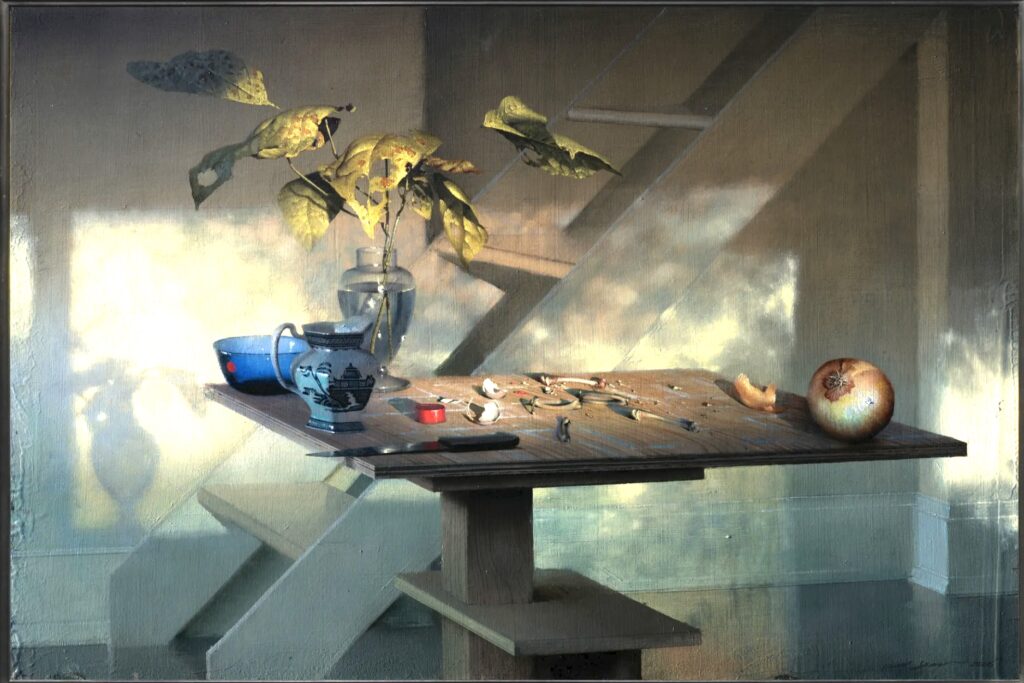
Spells Being Cast
Daniel Sprick’s solo show at Arcadia Contemporary was an amplification and possibly the completion of his solo show there nearly two decades ago. As before, it presented a series of perfectly realized views of his studio, offering a sort of spiritual and psychological X-ray of his identity as a painter. Aong with the magnificent Raphael exhibition at the Metropolitan, What Remains provided a glimpse of mastery rarely seen in contemporary painting. Sprick’s work serves as an apt antipode to Raphael’s immense and passionate Italian warmth: these studio interiors seem to have been transported from cooler, darker Renaissance Germany, as if Hans Holbein and Albrecht Durer found a way to teleport Daniel Sprick into this century to show us how painting ought to be done. His sobriety and gravitas give birth to great beauty. Sprick’s handling of paint equals Gerard Richter’s. Sprick has that same perfection of surface, the rich texture of perfectly applied oil paint, feathered from one tone to the next, so characteristic of Richter’s work. Yet he also can make the paint disappear in the service to his visualization of objects exquisitely tangible in the manner of a Golden Age Dutch still life painter.
His vision is both mundane and hauntingly mysterious. Eldritch is the recondite adjective one might fish up for Sprick’s work, but it isn’t quite right: the lurking menace implied by that word isn’t part of Sprick’s world. In his earlier show he was a hungry ghost. His haunted, twilight vision craved a fully alive, productive interior space where he could recreate the incredibly subtle ways light falls on a fairly small collection of objects. There were a lot of bones. Yet these studio scenes weren’t catacombs but work spaces full of potential energy. It’s always a contest with Sprick, in a way, between the fascination of the objects themselves and the spell cast by that light. In his 2007 show, Sprick returned to a small set of objects again and again, like Chardin, arranged differently in slightly different areas of his studio, exploring variations of his theme, a mixture of classic vanitas painting with an intimate vision of familiar, useful objects, left in a state of handy disorder, waiting to be used. His pictures could both attract and push you away at the same time, like Holbein’s The Ambassadors, offering all the vitality and immediacy of lived experience, but with a strange fissure in the floor that turns out to be a ghostly human skull, elongated, leaking into the scene, a reminder of this world’s vanity.
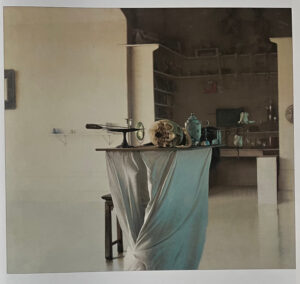 What was so remarkable about Sprick’s 2007 exhibition was how he illuminated his scenes with a diffuse natural light, often from two different directions. A warmer light flooded in gently from large windows to the left, in The Memory Jar, while a blue light, reflected off the opposite sky glowed in folds on the other side of the pedestal he wrapped in white fabric. This duality of light defined most of the paintings from that show. The cool, blue reflected light enabled him to bring his still life objects into greater relief against the ambient, pale Naples yellow of the more direct sunlight illuminating the rear walls and alcoves and shelves. Against that polarity of light sources, he juxtaposed the Dutch clarity of the foreground objects against the soft, diffuse, slightly unfocused rendering of the backgrounds. For those, he used a Richter handling of paint that creates the photographic immediacy Richter loved, mimicking the different focal planes offered by a camera set for shallow depth of field. It’s a subtle way to create a third level of balance between opposites: the overall feel of Northern Renaissance clarity and melancholy austerity in tension with the hazier contemporary warmth of the walls that seem to melt into the floor as they would in a certain kind of cinematography. The walls sometimes looked as if they were translucent frosted glass lit from behind. They have the warmth of sunlight but the emotional neutrality of a florescent glow.
The recent show breathes new life into his studio interiors. These images feel alive, crisp, fully present: the disjunction between the evocation of the past and our contemporary life has receded. His backgrounds are much more clearly defined, the floors distinct from the walls, and it’s an almost physical pleasure to see how he captures the sharp turns in the baseboards of a white wall now. He brings the viewer into a much more intimate relationship with what he’s depicting in various ways. His previous, almost monochrome palette, has advanced to a tremendous—though still restrained—sense of intense color. He has embraced a new range of color with quiet passion. He uses these highly saturated areas sparingly, bringing the eye toward the sweetness of a brilliant red or shimmering blue, while creating a more neutral field of light around those focal points.
Spells Being Cast offers a standard around which much of the rest of the work revolves. As he did twenty years ago, Sprick uses his tables, pedestals, walls, and now a set of stairs at the back of his studio, to create a geometric, compositional grid as a foundation for the objects close to the viewer. He can create an almost abstract grid in the arrangement, the setting, in the lines and forms of what he’s showing. He composes his scenes so that a structural grid is there, inherent in what’s seen. In this painting, the lyrical color is concentrated in the objects, huddling near the rear corner of a pedestal holding up a square of high-density plywood. In the one corner, a blue glass bowl, a brilliant red pill box, a glass vase in which he has arranged some decaying catalpa leaves, all of it balanced, at the opposite corner of the plywood slab, by an onion. Between these opposing corners he has strewn his familiar small chicken bones, a couple cracked egg shells, and a knife. What’s most marvelous, though, is the direct light flooding across the scene from a large window behind the viewer. If I had to guess, I would say it’s an autumn light from the first hour after sunrise. This is what he has evoked with his background: the direct light shines through a tree outside, then through the window, which is fully in view via the shadows cast on the back wall. The shadow of the vase establishes the direction of the light and, then across the white staircase, the wall and the floor, you begin to see how the sunlight is casting muted bronze and sienna tones, filtered through the turning leaves outside. Vanitas remains, in a way that doesn’t require a skull. It’s incredibly subtle, in the decay of the catalpa leaves, the discarded bird bones, the broken shell and the autumn leaves. To capture the brilliance of sunlight falling directly onto objects in a room and yet not lose detail in the darkest shadows (the way Caravaggio might have evoked a shaft of light falling into a dark space) is an extremely difficult feat. To be able to paint this way is in itself a major achievement. But after two decades of painting, Sprick has refined even more skills and his worldview has opened up accordingly. He shows us now how the present moment counts most of all. The reminders of mortality are still an anchor, but he shows the actual life that’s passing, the loveliness of it in the humble objects of everyday life. There is still a heavy Dutch influence in these interiors, but it’s Vermeer’s light now, Vermeer’s blue and pale gold, Vermeer’s love of home as a subject able to convey deep wisdom and beauty.