Alive and well: Fairfield Porter’s Unique, Radical Wisdom
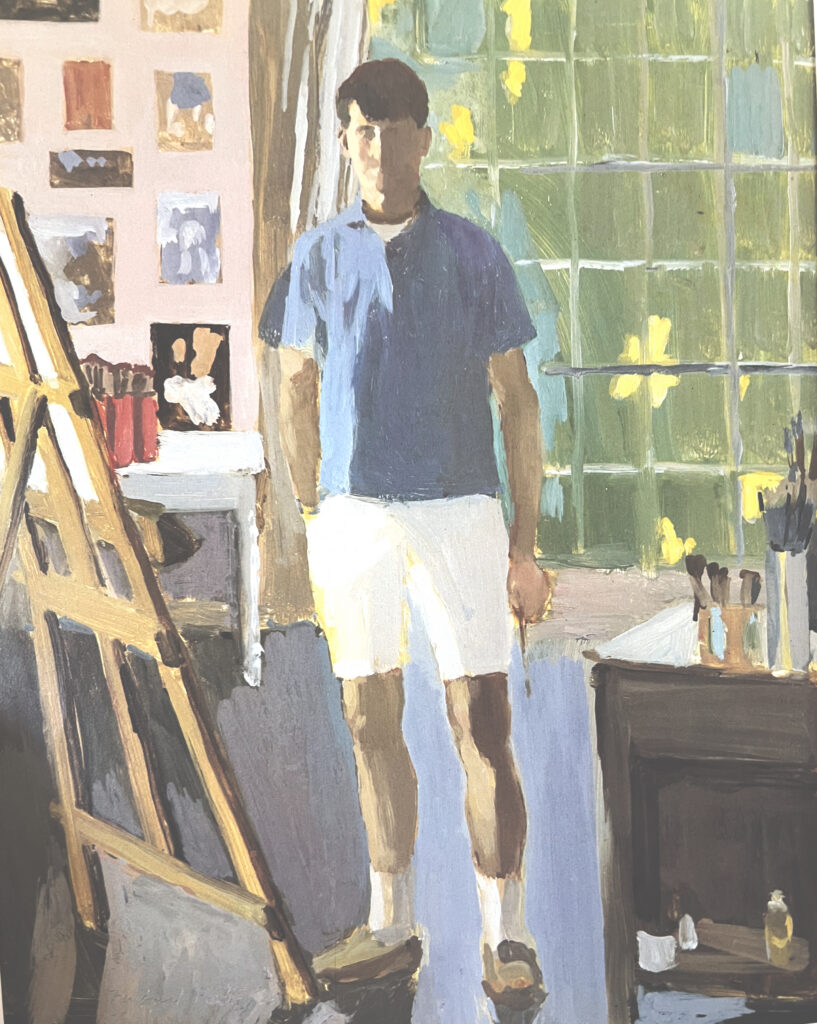 Note: This essay is dependent, for the facts of Porter’s life, on two excellent biographies, Fairfield Porter, A Life in Art by Justin Spring and another biography which serves as text for a catalog of his work, Fairfield Porter, An American Classic, by John Spike. I have yet to footnote all of what I’ve drawn from those books here, but intend to. Also, I’ve drawn from the 1968 interview by Paul Cummings archived at the Smithsonian. This has to be the longest post I’ve done, but it could easily be much longer.
I didn’t get a degree in art in the 70s because I found the whole enterprise of visual art increasingly empty and dcontrived even half a century ago. With many marvelous and rare exceptions, much of visual art has become increasingly so. Despite this seemingly inexorable decline, painting remains alive and well. Prices for blue chip painters are now so high everyone must worry that it’s all the grandest economic bubble in history, especially since significant galleries have been dropping dead for so many years. Visual art finds a smaller and smaller audience, much like poetry, as the years pass. And yet prices keep rising, meaning the market for art gets more and more exclusive while fewer and fewer people are interested. Something has to give.
In my teens and early twenties, after what happened in the art of the 50s, I couldn’t discern how art could break new ground anymore. It was over. I kept painting, but in a dispirited and stubborn way, pretending that it mattered. I decided to make a living as a writer. Then, more than a decade after I emerged from graduate school, I saw my first Fairfield Porter exhibition at the Albright-Knox, and Arthur Danto wrote that the history of art was done and now anything was possible. I realized I could paint any way I wanted to paint and consider it a serious undertaking.
Nevertheless, the fact that nothing is forbidden in visual art cuts both ways, and that kind of freedom has resulted in a massive smokescreen of postmodern cant in the past half century. There has been too much calculated thinking, too much cleverness, too much interpretation of less and less visually compelling work. There is precious little of the involuntary obedience to the “inner necessity” Kandinsky talked about. Dousing for that inner necessity is what it’s about, but in an individual, not historical, way. Instead of seeking this imperative individually, many artists now know it’s all been done before, in formal terms, and so they have to lard into the work some postmodern irony and “meaning.” What they lack is a genuine inner want. A craving to do something uniquely particular with a physical image involving form and color and light. Great painters ignore art history, except to fall in love with the work of previous painters. They paint as if nothing mattered but the need to make something exactly as it needs to be made, even if at first it looks like something familiar enough to have been done before. Finding that inner need remains a mysterious grail.
Fairfield Porter found it. He figured this all out, ahead of his time, seventy years ago. I’ve been studying his work and his life over the past few months. Reading more closely his two biographies and what he wrote as a critic, I recognize him now as the wisest and most radical American painter in the past hundred years, alongside Burchfield, who ranks closely behind Porter. I’m posting this rough draft of a longer essay on Porter since one of his great paintings is on view for one more day at David Zwirner in The Great Unseen Collection: A Selection of Works from Joel and Carole Bernstein. The show runs for a few more days at 525 West 19th Street. Meanwhile, the Art Students League has mounted the largest show of his work in New York City in a quarter century. It will be on view into August.
It’s about time. Porter is the most unique American painter of the 20th century precisely because his intellect—and the twin specters of art theory and art history—never entered into the production of one of his paintings. He stepped out of the entire cerebral flow of modernism as it morphed into the postmodern, and he painted in a way that rejected discursive thought itself. It resulted in paintings that probably look to many people like the work of an amateur, or a child, but in the best ones he unconsciously achieves a seemingly effortless and natural execution superior to almost everything American painting in its simplicity. His life was extremely unconventional, but his work conveys an utter sense of normalcy and balance, and his vision serves as a kind of Zen accompaniment to a more popular Norman Rockwell view of American life. His vision is normative, even though his life itself was anything but. He was more interested in capturing perfectly a certain quality of light and color than in depicting an ideal way of life, yet he unconsciously did just that. His vision of life emerges incidentally, not intentionally, throughout the entire body of work, on its own, as a byproduct of his attempt to make a painting breathe.
He was a psychologically wounded man, like Andre Gregory, able to live fully in his art, but not his life, though he managed to successfully raise a family and remain married to his Catholic wife despite his “transgressive” personal behavior and his inability to embrace her religion. He loved her mystics and her saints, but not her Pope. As radiantly commonplace as his images became, he lived in a way that was (in its moments of extremity) almost hilariously unconventional and slightly unreal. He never earned a degree in painting or studio art of any kind. He found instruction desultorily but considered all of it useless, an education by bricolage, except for some guidance in middle age that he got from someone he met by accident at the Metropolitan Museum of Art. Formalized instruction did nothing for him. Brief, unexpected encounters with previous art and other individuals proved crucial to his ability to mature as a painter. When he eventually became a teacher, he operated more as a guru than someone offering principles or methods or anything systematic or even repeatable. He abhorred what was repeatable. Much of his own life advanced in little quantum jumps to new levels of achievement in ways that took him by surprise.
2
In the short version, his life sounds like a Nick Carraway pilgrimage. It’s major arc is from an affluent Chicago suburban upbringing to an East Coast sophistication divided, in adulthood, between Maine and the Hamptons. (Southampton wasn’t a Gatsby Gold Coast setting, but where the genuinely wealthy summered between July 4 and Labor Day. Porter’s situation was, well, a bit different: an 1840 house heated with coal stoves on 78,500 acres of land with a lake, a barn, an orchard and a short walk to the ocean. It was a property straight out of his beloved Chekhov.) He grew up as a middle child with three brothers and one sister; one brother, Eliot, (his mother’s cousin was T.S. Eliot) became a well-known, popular photographer. It was a comfortable childhood, but an uneasy one. One gets the impression the entire family was emotionally unavailable to one another. Porter’s biographer, Justin Spring, describes the dinner table as seven people, each reading his or her own book silently while finishing their meal—an early version of a speechless meal with iPhones. “The Porters made a regular practice of bringing books to the table and, upon finishing the meal, immediately falling into a silence broken only by the clearing of throats or the rustling of a page. Nearly everyone who visited the Porters, either in Winnetka or at their summer home in Maine, remarked on the stillness.”
His father openly admitted to Porter that he disliked him, even though Porter spent his life trying to succeed in a creative field partly because his father, James Porter, was a disappointed architect. When the Porters hit the jackpot in a real estate sale, James surrendered to the role of asset management. When Fairfield showed interest in architecture and visual art, his father dismissed it and denigrated his talent. James Porter was an unhappy man with a short temper, traits the son inherited. The Porter family divided its time between Chicago and Great Spruce Head Island in Maine, an island in Penobscot Bay his family owned, where Porter’s father designed and built a big, drafty and cavernous vacation home, described more as a camp shelter than a house. It did have its own tennis court, a setting for one of Porter’s finest paintings. This rustic island retreat and its surrounding views remained one of Porter’s favorite subjects throughout his life.
As a kid he already had an upper middle class upbringing in Winnetka, half an hour’s drive north of Chicago, before his family became independently wealthy overnight by selling what was to be the most valuable land in the Midwest. It was land where there Loop was built, the second largest business district in America behind Midtown Manhattan. His inherited wealth made possible his career in writing and painting, though after years of not tending his trust fund’s burn rate, in the 60s and 70s he began earning money as a teacher.
Porter was almost entirely self-taught. He got an art degree at Harvard, but not the usual kind. He avoided training. “I got a degree in fine arts, but just barely,” he said. He meant that he got a B.S. in art history. After graduation, he sought instruction at the Arts Students League in New York, studying with Boardman Robinson and Thomas Hart Benton. It made sense at the time: they were focused on murals and he wanted to paint Communist ones, tributes to the workers of the world. It was a waste. Nothing they taught helped him find his way toward who he became as a painter. He chose to learn through trial and error. He travelled to Europe several times over the years, the first trip taking him onward from Europe into Russia. But of course it was all serendipitous. He ran into friends from home who invited him along to Moscow. There, he actually spoke with Leon Trotsky at an event where one of the members of his group asked snidely how the Bolsheviks could know that most of the Soviet population supported the Communist regime when the country had no civil liberties or an actual vote. Porter had that same sense of humor and lucid intelligence, but it took him two decades to leave his passionate Marxism behind, after spending seven years attempting a career in painting those Socialist murals. (Later in life, he became less opposed to capitalism, abandoned his , politics and was far more troubled by the looming power of science and technology.) On a second visit to Europe a few years later, he stayed with Bernard Berenson, the world-famous art critic, whose work on Renaissance painting gave Porter an orientation for judging the quality of a great figurative painting. Meanwhile he was learning nothing about how to handle oil paint.
The arc of his life when he returned to America can be outlined as zagging when others zigged, stumbling into small revelations that steered him toward mastery, networking his butt off, in a very calculated, careerist way (a strategy almost the exact opposite of the pure, spontaneous way he learned to paint) while trying to overcome the slightly Asperger’s tenor of his interpersonal relationships. His life and career were deeply dependent on the help of his friends, who ultimately gave him the introductions he needed to become an art critic and a commercially successful painter.
On his return from Europe, during his marriage to Anne Channing, they lived in Maine and then moved back to Winnetka. This backsliding move was crucial: it offered him access to a big exhibition of work by Vuillard and Bonnard, at the Art Institute of Chicago. This was one of several pivotal moments in his life: it revealed to him the possibility of a loose, almost instinctive use of paint to depict ordinary middle class life in a poetic way. What he saw in Vuillard was that painting was essentially a form of play, not work. It also demonstrated the value of depicting bourgeois contentment rather than social justice. To say the least, this opened a door that eventually lured him away from his Socialist murals. The Porters moved back to the East Coast and stayed both at Great Spruce Head and in various homes in Manhattan, and they finally bought the house on Long Island.
All the while, Porter used his writing skills and his insights into the work of other Manhattan painters to burrow deep into the New York School, as a critic and painter and eventually a published poet. He became close with key figures in the downtown scene: Willem de Kooning, Alex Katz, Larry Rivers, John Ashbery, Frank O’Hara, and James Schuyler and dozens of others. Porter was the first critic to recognize de Kooning’s stature as a painter, and his appreciation for the painterly surface of that work became one of the foundations of Porter’s own handling of paint. In 1951, after he had, with Elaine de Kooning, what was for her an impressive dispute about the worth of Arshile Gorky, she eagerly recommended him as an art critic for Art News. This eventually led to his stint as a predecessor of Arthur Danto at The Nation. He became friends more and more figures in the ambit of this influential circle. He disliked Clement Greenberg, and he considered his influence over the art world as almost tyrannical. He hated ideas and Greenberg was full of them. He hated theory, period. With shrewd calculation, in a remarkable way more suited to a CIA asset than an art student, well before he’d achieved any mastery or originality as a painter, he drilled into the heart of this creative coterie as it helped shift the art world’s center of gravity from Paris to Manhattan. Yet, as a painter, he achieved this insider’s rank almost prematurely. It took him time to catch up, in painterly skill, with his rarified role as a sort of professional insider within New York City’s creative cutting edge. And yet, in 1952 he began to exhibit his early work at Tibor de Nagy, thanks to the recommendations of Willem de Kooning, Freilicher, and Rivers. He refined his aims and simplified his means as a painter in the 50s, defining how he would paint from then on, but he really only became fully himself a decade later in the last fifteen years of his life. He mastered his art slowly, uncertainly and with continuous disappointment in his own results. As a critic of others, he was generous, almost empathically appreciative of anyone utterly unlike him, but for his own work he kept an incinerator handy. Many canvases went up in smoke.
He enjoyed his fifteen minutes of fame, as it were, in the early 60s. He achieved critical recognition, and therefore sales, as the Manhattan cognoscenti went fishing for what was essentially the Next Old Thing, as it were, while AbEx lost some steam. It was a shift of attention briefly backward into representational painting, critics taking a deep breath of fresh air before floating out into the fishy delta of modernism streaming outward into a dozen different ways to make art. The years from 1960 through 1964 were a sea change into something rich and familiar for Porter. His first exhibit in Tibor de Nagy’s new location was, according to his son Laurence, “A sudden, miraculous, and permanent improvement in his painting.” David Rockefeller put one of his paintings on reserve, and wouldn’t let go of it when Jackie Kennedy asked about it. This was the advent of those last fifteen years of brilliance before he died. He was interviewed by Newsweek. He was given the cover of Art News in 1964, with a feature story on him entitled “Fairfield Porter: Minimum of Melodrama.” Time magazine profiled him along with Wayne Thiebaud and George Segal. A year later, as Justin Spring points out, Pop and Minimalism took center stage and traditional representational art returned patiently to the wings. Yet Porter’s reputation quietly grew stronger and stronger among critics and painters as the general public lost awareness of him. The Cleveland Museum of Art held a retrospective of his work in 1966. In 1983, when the Museum of Fine Arts in Boston held a Porter retrospective, Hilton Kramer wrote in The New Criterion that history would have to be rewritten to recognize Porter as “one of the classics of our art.” Yet, even now, Porter remains more obscure than hundreds of lesser painters. Many accomplished artists aren’t that familiar with him. In 2024, Harvard published in its alumni magazine a short piece about his life that begrudged him only faint praise, calling him An Underknown 20th Century Realist Artist.
3
The clemency of Porter’s serene images suggest an ordinary happy life among family and friends in an America at the peak of its post-war abundance. His work reveals the generous beauty of a commonplace world. But his vision doesn’t reflect the complexity of his unconventional life. Psychologically wounded from his upbringing and hindered by a whiff of Asperger’s (his first son was severely autistic), he struggled to gain his emotional bearings throughout much of his life. He was prone to wild infatuations with other individuals, both men and women. Anne and Fairfield had an open marriage. He believed in free love as a sort of adjunct to his Marxism. But it wasn’t a happy arrangement. Already married, he fell in love with Ilsa Hamm, and he made her uncomfortable by continuing to pursue her after she married. Having grown up with a cool remote father, he developed intense emotional crushes on other men. Only in the domestic arrangement of his homosexual relationship with the poet James Schuyler did he find some genuine reciprocation of his affection. Schuyler and the other New York School poets had a deep appreciation for Porter’s work, an admiration he never got from his dad.
With Schuyler, it was all quite odd. What was eccentric wasn’t so much Porter’s bisexuality—much of the New York School circle, especially the poets, were gay. What happened was that Schuyler simply moved in and became part of the family. He had a reputation as a bit of a freeloader, like Rilke hopping from one castle to another as a houseguest. Ilsa Hamm had sussed him out earlier as a manipulative sponger. The Porters didn’t mind. Yet the fact that Schuyler actually lived for years in their home proves that Anne has to be one of the most tolerant and long-suffering wives in a long line of spouses who have had to endure being married to a painter. One speculates that she relied heavily on her Catholicism to get her through it, especially when Schuyler had psychotic episodes and had to be hospitalized during nervous breakdowns. Porter’s own children struggled with psychological issues. Autism with his first son. Another had a brief fling with pyromania. A third developed “a passion for violent games.” All but Johnny, the first child, navigated through it ultimately to a productive adulthood.
The eccentricities started early. Back when the family moved back to Winnetka, Porter was still in full Socialist mode hoping to paint murals devoted to the workers of the world. Needless to say, he wasn’t a great fit for that affluent suburb. At his home he would host models, Socialist and anarchist friends from the Chicago slums, and at times various actors and professional acrobats would mingle with his favorite Leftists. The artists’ models would stick around all day and into the night. Back east, when the couple set up housekeeping in The Hamptons, these bohemian traditions would continue in different form, with all of the creative insiders Porter knew from his time spent in their studios and in his residence at the ten different homes the couple inhabited successively in Manhattan itself, one of them near MoMA. In retrospect, the family sounds like a sort of traveling circus, a strangely dysfunctional couple with slightly bewildered but bright children who watched their parents pull away from each other and then reunite in a lasting bond Porter’s behavior couldn’t break. He was impulsive, both talkative and reticent—he would show up at a table and begin talking animatedly in mid-thought as if he’d been there for an hour and then get up and leave abruptly and silently without warning. He had fits of temper like his father. Driving toward a railroad crossing, he once floored it and tried to outrace an approaching train. He lost his race. In the hospital, Paul Georges came to his bedside and said in praise (that had to be a bit of a put-down as well): “It’s the most interesting thing you’ve ever done.”
4
Fairfield Porter’s ambition was to paint without knowing how to paint—without calculation or repeatable techniques, without stylization, without any conscious messing with his immediate response to the visible world around him. He wanted liquid marks that all cohered with one another in a whole that conveyed the way light and color look in the actual world. He wanted every square inch of a canvas to look alive.
Porter summarized what he wanted to achieve:
Well, I think that color should be alive. I agree with the remark of Matisse that he use to make to his pupils that every corner of the canvas should be alive. That’s a matter of the inner relationships of the areas to each other, and it’s also a matter of contours. They’ve got to be alive. It’s a matter of both drawing and color.
He made some large canvases, but always he painted unspectacular, often unpicturesque subjects guilelessly. He didn’t stalk his viewer. He does little to attract attention to what he shows you. What he said about Tolstoy, Chekhov and Velasquez, in the marvelous 1968 interview by Paul Cummings archived at the Smithsonian, applies equally to himself.
They “leave things alone:”
I think Velazquez (is) better than any other painter now. But I saw (Velazquez) again. I was beginning to be interested in what you can do with paint, what is the quality of paint, what is its nature. And this liquid surface of Velazquez, I admired and also what might be called understatement. Although I don’t like that word really. The impersonality… I don’t know what word to use. He leaves things alone, you know. It isn’t that he copies nature, but he doesn’t impose himself upon it. He is open to it rather than wanting to twist it. Let the paint dictate to you or let yourself be dictated to. I think there’s more there than there is in willful manipulation.
Porter was all about the paint and much of his struggle to find himself as a painter was a search for how to make the paint feel a certain way when it came off the brush and sat on the canvas. He loved de Kooning and was the first to recognize de Kooning’s originality. At first glance the two painters hardly seem to have anything in common. Yet Porter wanted what de Kooning showed: the understanding that putting down a certain quality of paint itself could be the whole purpose of making a painting. He recognized how AbEx was tapping into an instinctive, subconscious energy, adopted from surrealism, but it simplified this life force into mark-making rather than depiction. The paint was the point. The paint embodied gesture in the mark, and gesture for the abstract expressionists (and for Porter) was almost the equivalent of literary surrealism’s practice of automatic writing. Gesture was life.
In mid-life, Porter studied briefly with Jacques Maroger and adopted “the medium” Maroger claimed was the essence of great painting for centuries: it worked, freeing Porter up to be able to put down exactly the sort of marks he needed and additionally it let him then push the paint around without destroying its fresh alla prima quality. But his most crucial breakthrough was while he was copying a Tiepolo study in the Metropolitan Museum of Art. It led to an encounter that enabled him to achieve the mastery of his last two decades. Justin Spring describes it:
While at work in the Metropolitan, Porter had an encounter which took on the aspects of personal myth. He was accosted by an odd and unpleasant-looking man, “a little man with very, very bad breath,” a “Belgian painter”* later described as “a Frenchman with a Dutch name who said he had known Degas, Renoir, Bonnard, and Vuillard,” who eventually introduced himself as Georges van Houten. Van Houten, known in Europe simply as Georges Houten, had exhibited nudes and landscapes at the Salon des Independents in Paris beginning in 1910. He told Porter, “You have light in your pictures. Most of those copyists don’t have any light in them.”
Porter then spent several days taking instruction from him, and what emerged from this serendipitous tutelage was his conviction that a certain quality of light and color were essential to his vision. In his last two decades, and especially the last fifteen years of his life, his work was, as David Shapiro put it, “a religion of light.” He had artistic ancestors in this: Tiepolo, the Impressionists and post-Impressionists, Van Gogh (whose letters Porter treasured), Matisse, when he was living and working on the Riviera, and even his beloved Velasquez in The Surrender at Breda. Yet in comparison with all of them, in some of his great paintings Porter seemed to have discovered a light amplifier that could be turned up to eleven when theirs only went up to ten. Shadows in his paintings hum with color. There’s virtually no darkness in his field of vision. An illuminated twilight is as dim as it gets when Porter arrived at his final mastery. This is partly what makes Porter so companionable, so accessible to nearly anyone, the way Van Gogh is: both painters exulted in a kind of perpetually illuminated world, indoors and out, in a way that makes everything look as if we’re seeing it for the first time. Everything in Porter is a clean, well-lighted place. Even the most disorderly of tabletops. The world we usually see in his work is friendly, what most of us see in our own mundane daily lives: a tennis game, a county crossroads, a table set for breakfast, a little girl sitting calmly in a chair, or a spouse recovering from illness in bed.
This is what meets the eye. Yet what is operating in all of this was a state of mind and heart he described as “transparent.” Few critics have compared Porter’s attitude toward the act of painting with phenomenology, but he attempted to do what the phenomenologists did: put everything known into brackets and simply look with new and unsophisticated eyes at a world available to the senses. He wanted to extirpate thinking and knowledge from the act of painting. He sought a Zen-like state of no mind. He liked David Hume’s observation that all we know is a stream of sense experience. The old Imagist motto fitted well: no ideas but in things. Sensory stimulation wasn’t the point: Porter wasn’t a hedonist, though his paintings offer great pleasures. He talks about achieving a certain kind of awareness, a certain quality of paying attention, not to a particular object or place or thing, but in every painting to be as aware as possible of the entirety of the world as it is embodied in unique, eccentric particulars. What he seeks is an almost Proustian awakening for himself and for the viewer. He wants to be aware not just of the unique and particular quiddity of everything he sees, but to the wholeness of the world and life, so that the glimpse he offers of one tiny corner of the cosmos reflects that wholeness: “everything.” In Proust’s world, a meaningless sip of tea resurrects an entire world. In Porter, as in Van Gogh, a pair of shoes might work just as well. As he told Cummings:
I like in art when the artist doesn’t know what he knows in general; he only knows what he knows specifically. And what he knows in general or what can be known in general becomes apparent later on by what he has had to put down. And that is to me the most interesting art form…. in other words, you are not in control of nature quite, you are part of nature…. the whole question of art is to be wide awake, to be as attentive as possible.
For someone who wrote for a living much of his life, and who was also a voluminous reader, he found himself struggling to put into words his most crucial insights. One could say, with a smile, that this was also a problem for Heidegger and Wittgenstein, who both wrestled with the limits of language and thought, who preferred silence to philosophy when it came to the most profound contemplation. The limits of language play a role here. But Porter gets pretty close to articulating how painting begins where thinking ends. His outlook is almost that of a secular mystic: he practiced various forms of meditation in his later years when he was also reading Juliana of Norwich, William James, and Plotinus. Though his wife converted to Catholicism and brought more than one of their children into the Church as well, Porter never dropped the bearing of an atheist, but what he understood about painting and the nature of consciousness was echoed in work by those who had a more conventional view of the spiritual world.
Without ever putting it this way, Porter was devoted to what the Greeks called nous, the seat of awareness in the heart, not the head, an intelligence that isn’t discursive or involved in the logical powers of science or technology. It isn’t feeling or emotion, but a way of beholding the world that, collaterally and secondarily, triggers profound feeling. His work is an attempt to open the eyes of this larger intelligence through moments of sensory perception. He stressed an open, transparent and impersonal state of awareness as the discipline this awakening required, as the foundation of the intense, purposeful application of paint to canvas: it’s why he made pictures, but he understood there was no way to make this kind of awakening happen through method, technique, or repeatable stylistic maneuvers. It couldn’t be taught. In a way it couldn’t be reliably learned. He never cites Ralph Waldo Emerson’s metaphor of the “transparent eyeball,” one of the least felicitous tropes in American lit, but it’s exactly what Porter wanted to become. (Emerson happens to have been one of his wife’s ancestors.)
His remarks in the Smithsonian interview keep circling around this quasi-mystical approach to paint:
You get it by following – not by ordering the thing or using your head – but by being unconscious.
What I admire in Alex Katz’s paintings… I was talking to a young poet, who came around here yesterday. He said he liked my paintings, and he showed me some of his poems. I couldn’t explain to him what I liked in Alex or I didn’t. He thought of him as simply putting down the “thingness” of things. But it isn’t that. Partly what I like in Alex’s pictures when I like them is it reminds me of the first experience, of a first experience in nature, the first experience of seeing. Expressionism doesn’t interest me very much, expressionism as a problem. But visualness interests me very much. It must be that “first-timeness.” The world starts in this picture. That’s what I’m interested in doing, I guess.
When I think art is not silly – and this is not a question at all of “modern” art versus another kind of art, but of the whole activity – it is because I imagine that being an artist also sets an example in opposition to all of the evils and destructiveness of scientific technology, which … I think is at the bottom of all the troubles of the world today. There is no point in going into this at greater length. It is, though, the basis of what I teach, even though only implicit in my criticisms of students’ work. I think we have to begin the world all over again, in opposition to technology and progress. We have to live in such a way that our lives do not separate us from the material world, as technology does. It seems to me that almost everything that is taken unconsciously for granted as important or valuable today is just idea and generality; there is nothing concrete there, no facts. When painting counts for me, there is at least the fact of the paint itself, and when I don’t like it, it is because it is all idea . .
To say, half a century ago, that technology separates us from the material world is to have seen clearly into a visual future dominated by phantoms on luminous screens. And again, on how thinking and arranging and consciously imposing form is to create chaos not order:
I see an arrangement I like. All I did was to arrange that chair for me to put one hand on. I thought of that. The rag on the floor was there and I liked it. Almost always in still lifes, I don’t arrange them. This still life was arranged but usually just the way the dishes are on the table at the end of the meal strikes me suddenly. So I paint it. Part of my idea or my feeling about form that’s interesting is that it is discovered. It’s the effect of something unconscious like the dishes are in a certain arrangement at the end of a meal because people without thinking have moved things and then have gone away. I think it’s impossible not to get some sort of form if you don’t think about it. If you do think about it, you can get chaos; but if you don’t think about it, you get form.
In one sense this goes to the heart of how natural his images are, how natural his handling of paint is. He sees composition and form in what appears as a result of life being lived unselfconsciously. Which is exactly how he wants to build a picture. But this leads deeper into his understanding of consciousness. His most philosophically profound remark, and it comes and goes during the interview without fanfare and much recognition from Cummings, involves a sort of version of the insight that recursive intelligence—a mind that tries to contemplate the entirety of being, the whole of all things as a whole, including one’s individual mind and life—is handicapped in a very obvious way. How can the part grasp the whole? It’s like the very funny line from Stephen Wright: “You can’t have everything. Where would you put it?” What he articulates bears some familial relationship with Godel’s incompleteness theorem, the notion that a system of math can’t prove its own validity as a whole. The only proofs are within the system, not proofs of the entire system. A proof is an element of the whole, inside that whole: it’s a part of mathematics and not about math itself being valid or true. The mind can’t behold the entirely of the cosmos, or life, because the mind is operating as an element of that whole, from within it. It can’t get outside the whole in order to see it partly because it can’t step outside itself. As he puts it:
One of the troubles with the world today- the pollution problems and so on- is that scientists or engineers do not sufficiently understand that the world that they are studying is not outside themselves, but they are part of it. It’s bigger than themselves. They can’t enclose it in their own minds because then it would be smaller than their own minds and it wouldn’t be the totality of the world. In a sense, the value of art today is that it shows people—what science doesn’t—that what is real is everything and nothing less.
Which is what remains beyond the reach of the conscious, rational intelligence.
And then the interview moves on quickly past these fragmented observations which are begging for more elaboration, so it’s a bit like deciphering surviving fragments of Pre-Socratic philosophy. But this foundational insight, if Cummings had queried him to elaborate on it, would have shown how he saw the role of painting. It was a way of establishing (in full recognition of how the logical, discursive intellect can’t possibly gain a view of the entirety of what is) an individual relationship, a “connection” as he referred to it, with the wholeness of “everything.” Subconsciously, the work itself offers a small glimpse of the whole, in its wholeness. He and Cummings do circle back obliquely toward this in one small passage:
PAUL CUMMINGS: So . . . different people see different parts of the elephant as the joke goes. You think really then that painting is more of an emotional thing than an intellectual thing?
FAIRFIELD PORTER: No, I don’t think it’s more emotional or more intellectual. I think it’s a way of making the connection between yourself and everything.
PAUL CUMMINGS: How do you mean “and everything”?
FAIRFIELD PORTER: Well I mean “and reality” which is everything. In other words, you connect yourself to everything which includes yourself.
PAUL CUMMINGS: Through the painting?
FAIRFIELD PORTER: Yes, by the process of painting; and the person who looks at it gets it vicariously.
The act of painting smuggles this “everything” into the work, without the artist consciously being able to control it, or necessarily even being conscious of how or when this happens. Yet viewers see it in ways the artist can’t see it while making the painting. It can’t be willed or planned or reduced to doing something repeatable. But this almost meta-awareness of the everything-ness of everything is what Porter was after, in exactly the way this kind of awakening became central to Proust’s great novel, which Porter owned—though his family were devoted to the great Russian writers—inheriting the translations his mother had bought, one at a time, as each one was published early in the century.
5
All of this represents the inner scaffolding for what most of us who love Porter see when we look at his work. It is beautiful in the way that every Japanese haiku poem is beautiful: because it’s virtually lacking in all conventional significance and is absolutely real in a humble, ordinary way. The sound of a frog leaping into a pond is all Basho gives you, but in his brief poem it’s an echo from the beginning of time. In Porter you see your own mundane daily experience in a way that suggests what Porter had to have loved in his reading of Juliana of Norwich when she said “All shall be well.” What’s so refreshingly distinctive about Porter is how innate and natural his work looks. It gives you the vision of someone who comes back to a familiar home after years in exile or prison, years of being so long away from what’s normal and ordinary that everything is utterly new again, everything is a marvel and a wonder without being anything but what it was before you left. It’s what George Bailey gets when he wakes up from his Clarence-induced dream and sees his life with the eyes of his heart open for the first time.
Porter doesn’t strive for effect. If anything he makes his color as unspectacular as possible, and yet the result is exactly what’s required. He shows you just what’s there, but radically simplified in a way that is far from photorealism and yet occasionally appears to be a dramatically simplified distillation of a photograph. He wouldn’t admit to ever using a camera, but some of his best paintings, such as the glimpse of a tennis foursome awaiting an imminent serve, had to have been drawn from a photograph, and yet he still painted these as he painted anything from life, except it’s more accurate. That convincing precision of line and proportion afford great pleasure in combination with his sense of color. This compromise he undoubtedly found between the photorealism emerging around him and his early, much looser methods had to have been incredibly gratifying to paint. These paintings, including his homage to Las Meninas, could never have been considered candidates for the incinerator. The most distinctive of these few paintings, likely guided by snapshots, are The Tennis Game, Portrait of Nancy Porter Strauss, Lizzie and Bruno, maybe House with Three Chimneys, The Sweater, Interior with a Dress Pattern, Long Island Landscape with Red Building, and especially The Cove. There is a second tier of paintings that look slightly less accurate in draftsmanship but nearly as precise and appear to have been constructed carefully and methodically in terms of the drawing, and they belong among his best in this group: October Interior and July Interior, Summer Studio, Early Morning, Iced Coffee (on view at Zwirner), Columbus Day, Island Farmhouse, The Screen Porch, Table at Night, The Harbor, Great Spruce Head, and of course The Mirror.
It has been decades since I first saw a reproduction of The Cove, from 1964, and I hardly paused to look at it that first time, and I’ve spent little time studying it over the years since then. At first it looks a bit washed out, there is a lot of tan and brown and very muted greens. Only in the past few years have I begun to marvel at the quality of the painting, its marvelous marriage of precision of line and proportion with painterly brushwork. I’m convinced Porter had to have been working from a snapshot he took while walking along the Maine shore, probably with James Schuyler. Everything is indicated with the most generalized tones, eliminating all details under a certain threshold, a threshold set very high in favor of uniform shapes without detail, as it is in almost all of his work. Even what serves as detail, the shape and position of rocks, the figure’s socks, the rolled sleeves of the lavender shirt, are all generalized and hardly indicated, but they are there and vividly alive.
In this painting, as with the others mentioned above, he creates a stunningly convincing and realistic vision of a young man, maybe James Schuyler based on the shape of the head and body, walking carefully among stones revealed by the receding tide. The light, which at first looks washed out, is reflected off everything in the scene from a high sun in a blue sky at mid-day. You can feel it’s a hot summer day, heat radiating off the stones underfoot. Everything about this painting is perfectly executed according to Porter’s uniquely defined method of painting, arrived at personally, through trial and error. There’s nothing meretricious in it, nothing that adheres to what would be commercially or critically viable, though the praise and recognition he’d received in the previous four years had to have given him immense confidence as the painting unfolded and he could see that things were coming out exactly as he wanted.
The rocks ought to look like a mess, there’s so little distinction among them and almost no variation in color between the stony shoreline and the color of his figure’s khaki shorts. You could look at this painting and not even see the figure at first glance, and yet when you do see him, he immediately becomes spacially distinct—the effect is almost like a children’s book where as you open the page the figure or building or rocket made of folded cardboard rises up vertically from its flat surrounding page. He becomes the axis for everything on the exposed strip of littoral debris. The water in the cove is almost a uniform passage of gray, reflecting the sky, with a spiny border of dark green reflection of the distant tree line. That strip of dull green at the top is done in a brighter value, so that it recedes behind the cove, while an evergreen in the foreground is dark. Everything is done in the mid-tones, so that the hot sunlight radiates off the canvas, even though nothing is painted in pure white even in the clouds over the remote hill. There are so many ways this painting could have gone wrong, especially in the hollows and bumps of that shoreline (Thomas Hart Benton smiles), but somehow the spots of color, most almost identical with the spots around them, are perfectly defined in the most abbreviated way. The scene is so alive—the only word that Porter wanted to be able to say about any work of art—that you can walk into it. And you wish you could do that.
His greatness falls into two other categories as well, and one of them is what he was really after all of his life, where the painterly gesture takes precedence over linear accuracy but the scene is all the more alive as a result. He puts down one spot of color next to another, as Hawthorne put it, and the gestures of mark-making define the lines and forms of his images, likely done without any graphite sketch on the blank canvas. These had to be in a category where many of his attempts made it into the incinerator, because the process of painting them almost looks like a sport relying on instantaneous reactions, unpredictable mixing of colors, and rapid execution. One might smile and call it bullfighting with the blank canvas. That metaphor certainly fits de Kooning’s combat with canvas. These paintings are likely the ones he found himself most happy he had painted. Among them would be the incredible Still Life with White Boats, the equally dazzling Self-Portrait in the Studio, Apples and Roses, Flowers by the Sea, and a long series of still life in a format he returned to many times with transcendent results, tabletops strewn with random objects back-lit by windows, as well as the view through the screened-in porches around the Porter house in Maine. This format, still life in foreground and landscape through windows in the background, gave him a grid behind the objects in the foreground, rectangles of light organized by the frames and muntins of the windows aiming light into the viewer’s eyes. Three paintings in particular represent the kind of spontaneous perfection he could achieve when everything was working: the above-mentioned Still Life with White Boats, as well as a watercolor painted in his final year titled simply Still Life, in the Seavest Collection, and maybe the most beautiful image he ever created, The Table on the Porch, in 1971. What he achieved in the subtle and various use of color in these images goes beyond even the greatest color harmonies in his more laboriously painted work. The use of color for small details in the objects in Still Life is astonishingly accomplished and suggested work that awaited if only he hadn’t died so suddenly at a premature age. Again, he was much like Manet, moving up to the next level in his work, both with color and mastery of his brushwork, just as he was robbed of a chance to explore it.
A third category of his work, a small group of seascapes build on the nearly abstract images he’d painted earlier of the harbor visible from his house in Maine. This brief series of small paintings is so free in its brushwork and yet so visually accurate in the way it presents the values and tones of ocean waves that it’s as close to pure abstraction as Porter ever got. The images are as simple as they could possibly be, lacking in nearly all detail one usually sees in paintings of ocean waves, yet at a glance they are utterly convincing and real: A Sudden Change of Wind, The Ocean, and Morning After a Storm. They were painted in the early 70s, and are a corollary of these last very loose still lifes, but this little series conveys a sense of the eternal, an almost impersonal awareness of the cosmic, even while being simplified and quite literal depictions of how gentle, low tides move in and retreat on an Atlantic shore.
What makes Fairfield Porter radical, in a way unlike the monotonously thought-up and ostensibly revolutionary -isms that sprang up after Impressionism, is that he paints in a way that is entirely natural, unselfconsciously responsive to what he saw around him in his life. Many of his paintings are mediocre or unrealized. But the great work emerges almost randomly, year after year from the late 50s on. His whole project makes him the most trustworthy American painter in the 20th century. It’s as if, were the entire history of painting to disappear and one person were to pick up a brush and apply paint to canvas for the first time 70 years ago, something quite like Porter’s work would have likely emerged. He does what’s natural and spontaneous, without belaboring anything because he sees something he wants to remember. He abandoned the whole “totalitarian,” (as some characterized art criticism in his time) superstructure of intellectually governed art—art that becomes an illustration for an idea or a political viewpoint or simply a rigidly uniform school of painting, and thus serves as fodder for critics. He painted without a thought in his head, as a means of silent contemplation, in a direct relationship with the world he saw, with the “everything” of which he was a part. In protest to this notion, one can name the long list of work from the past that imprinted itself on his soul, starting with Giotto and Piero della Francesca, as well as all the artists whose work freed him up to do what he finally achieved, but his own work could easily have been done without any antecedents at all. It is the most human and unpretentious response of one individual to his own experience one can imagine, purposely lacking in intellectual justification, devoid of any discursive significance or meaning, and it’s this uniquely ingenuous quality that recommends him as a way out of what ails so much visual art now.
Great, Dave! You’ve done more (of course) than provide a suitable and effective setting for that tiny gem of a dialogue between Porter and Cummings – but if you’d done only that it would be a very worthwhile read.
Through Porter I believe you’re pinpointing the most important potential for art in our age, as well as its most essential reason for being from the beginning – helping us to make or feel that connection between ourselves and the “everything” that includes ourselves.
I can’t reflect for long on Porter’s quest for connection with “all of reality” without also thinking about the connected fates of art and religion in our culture (postmodern corporate capitalist consumer, but above all radically disconnected from relationship with the sacred).
I wouldn’t say I’d like to see a more religious world view to take hold in our culture – indeed, oddly enough, your description of Porter’s relationship to the art world makes me think of Dietrich Bonhoeffer’s call for a “religionless Christianity” – but spiritual openness and humility, yes.
A bit of a tangent, but sadly I’ve found the recent small surge of highly intelligent writing on art and faith to be coming from a place of inner smugness more often than from the humble “inner necessity” that can truly open writer and reader to the necessary relationship with reality. Maybe religious teachers and intellectuals these days don’t get that “relationship to the whole” right any more easily than people in the postmodern art scene you describe. They could learn something from Porter – truth is never something you can have “down pat” but must be alive and endlessly dialogical.
Your piece – maybe because it tackles such matters indirectly – is a positive exception, and I’m glad for it! I can’t think of anything we all need more than the earnest awareness of the need for that “living relationship with the whole” that Porter seemed to embody in his thought and was able to achieve in his art. Both art (as an institution) and religion – along with so many other things in our world – appear to be dying miserably for lack of what is found there.