Everything turns away
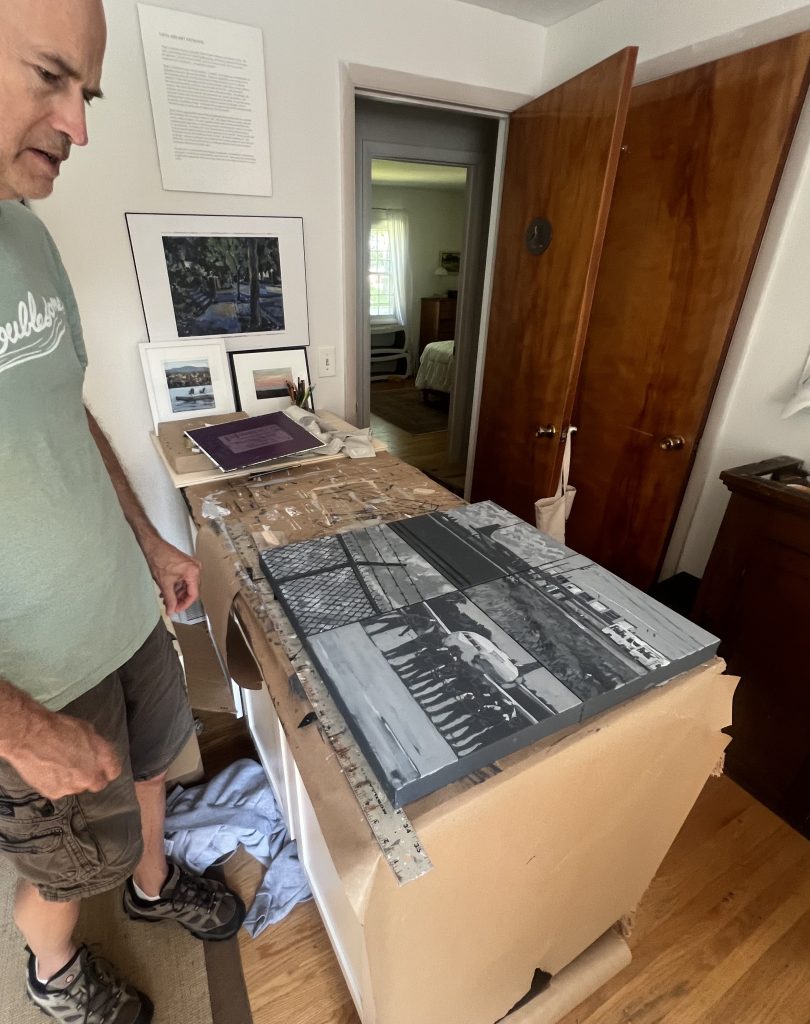
Jim Mott in his studio with four of the paintings for the RoCo show.
Jim Mott is showing some new work in RoCo’s exhibition about immigrant experience: Sanctuary/Borders and Belonging in 2026. It’s a bit of a departure for Mott. Though he’s been on the left politically most of his life, he has had reservations not only about much of what the far left has embraced in recent years, he’s also rarely been overtly political in his work. There have been subtle exceptions when, for example, he travelled to Ferguson, MO, on one of his itinerant painting journeys. His paintings of the place didn’t directly depict the social unrest or the shooting death. He has approached the subject of immigration, borders, and ICE in the same sidelong way. As with his in situ work from the past, in order to paint the places he chose, he made every effort to physically travel to the locations in New York State where captured immigrants have been detained and processed. Occasionally he had to rely on existing photography.
I was impressed with everything about the imagery he created. All of his contributions to the show were done strictly in a grisaille scheme of white, grey and black gesso. He doesn’t even get to the stage of painting with acrylic or oil. His palette matches the colors appropriate at a funeral. The mood is somber and the world looks as colorless as it does for someone suffering from depression, and yet these are some of the most accurately vivid and confident pieces he has painted—with a feel of vibrant immediacy. He constantly uses the geometry available in the photography he took to build a structure that lends power to the groupings. Some look pleasantly unfinished and elliptical: you almost aren’t sure about what’s being shown, but it lends to the intrigue of his entire approach: something sad is happening somewhere but where is it?
The paintings are all in uniformly sized, square formats, with four square images merged together to form a larger square. Each smaller painting is complete in itself, and there’s nothing continuous running from one smaller image into its neighbors, as there often is for painters who attach canvases for a diptych or triptych. Yet there’s a unity of light and mood that carries through all the assemblages. Many convey a very realistic quality of light at a certain time of day and season. Each larger square feels like a split-screen in a movie, showing various things happening in different places at the same time, yet often what’s happening in each vignette happens to be extremely undramatic, even static. The placard for a restaurant near a detention center. A close up of an insignia on a federal building. The Rochester, NY skyline near the river (not far from the federal building.) A grid of chain link fence. Each image reminds one of a short Imagist poem or that line from W.H. Auden’s poem about Bruegel’s Icarus:
…how everything turns away
Quite leisurely from the disaster; the ploughman may
Have heard the splash, the forsaken cry,
But for him it was not an important failure; the sun shone
As it had to on the white legs disappearing into the green
Water; and the expensive delicate ship that must have seen
Something amazing, a boy falling out of the sky,
Had somewhere to get to and sailed calmly on.