Alive and well: Fairfield Porter’s Unique, Radical Wisdom
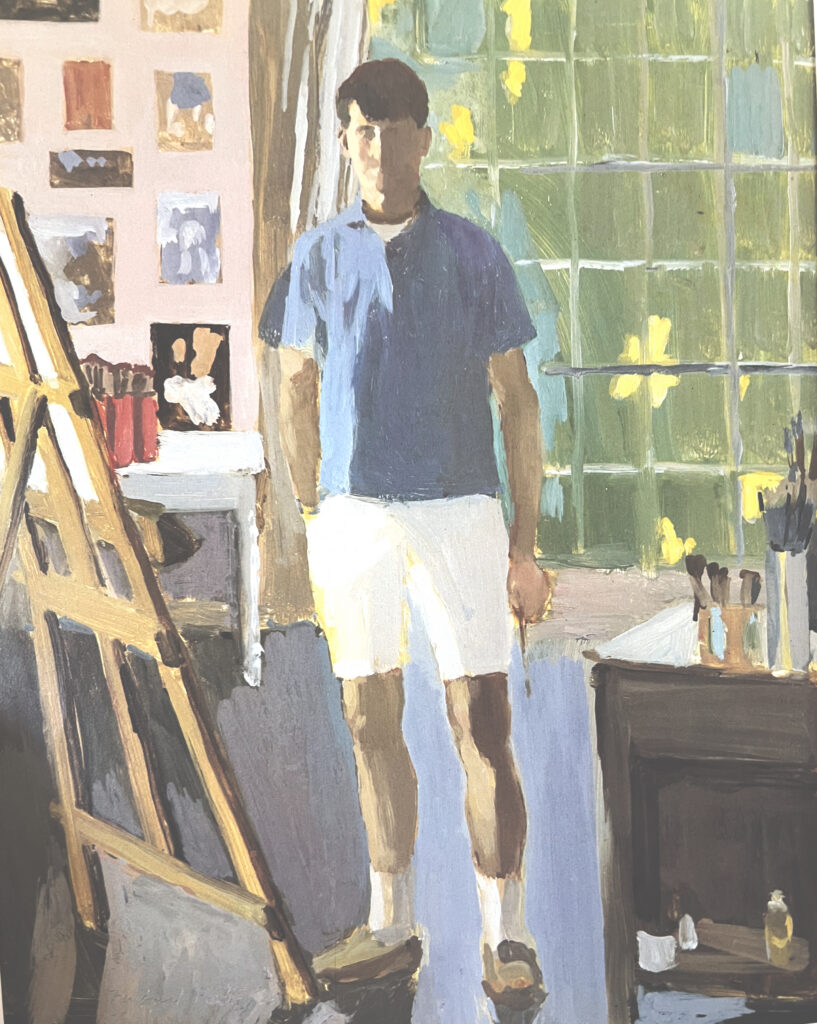 Note: This essay is dependent, for the facts of Porter’s life, on two excellent biographies, Fairfield Porter, A Life in Art by Justin Spring and another biography which serves as text for a catalog of his work, Fairfield Porter, An American Classic, by John Spike. I have yet to footnote all of what I’ve drawn from those books here, but intend to. Also, I’ve drawn from the 1968 interview by Paul Cummings archived at the Smithsonian. This has to be the longest post I’ve done, but it could easily be much longer.
I didn’t get a degree in art in the 70s because I found the whole enterprise of visual art increasingly empty and dcontrived even half a century ago. With many marvelous and rare exceptions, much of visual art has become increasingly so. Despite this seemingly inexorable decline, painting remains alive and well. Prices for blue chip painters are now so high everyone must worry that it’s all the grandest economic bubble in history, especially since significant galleries have been dropping dead for so many years. Visual art finds a smaller and smaller audience, much like poetry, as the years pass. And yet prices keep rising, meaning the market for art gets more and more exclusive while fewer and fewer people are interested. Something has to give.
In my teens and early twenties, after what happened in the art of the 50s, I couldn’t discern how art could break new ground anymore. It was over. I kept painting, but in a dispirited and stubborn way, pretending that it mattered. I decided to make a living as a writer. Then, more than a decade after I emerged from graduate school, I saw my first Fairfield Porter exhibition at the Albright-Knox, and Arthur Danto wrote that the history of art was done and now anything was possible. I realized I could paint any way I wanted to paint and consider it a serious undertaking.
Nevertheless, the fact that nothing is forbidden in visual art cuts both ways, and that kind of freedom has resulted in a massive smokescreen of postmodern cant in the past half century. There has been too much calculated thinking, too much cleverness, too much interpretation of less and less visually compelling work. There is precious little of the involuntary obedience to the “inner necessity” Kandinsky talked about. Dousing for that inner necessity is what it’s about, but in an individual, not historical, way. Instead of seeking this imperative individually, many artists now know it’s all been done before, in formal terms, and so they have to lard into the work some postmodern irony and “meaning.” What they lack is a genuine inner want. A craving to do something uniquely particular with a physical image involving form and color and light. Great painters ignore art history, except to fall in love with the work of previous painters. They paint as if nothing mattered but the need to make something exactly as it needs to be made, even if at first it looks like something familiar enough to have been done before. Finding that inner need remains a mysterious grail.
Fairfield Porter found it. He figured this all out, ahead of his time, seventy years ago. I’ve been studying his work and his life MORE