Santelli’s still humming along
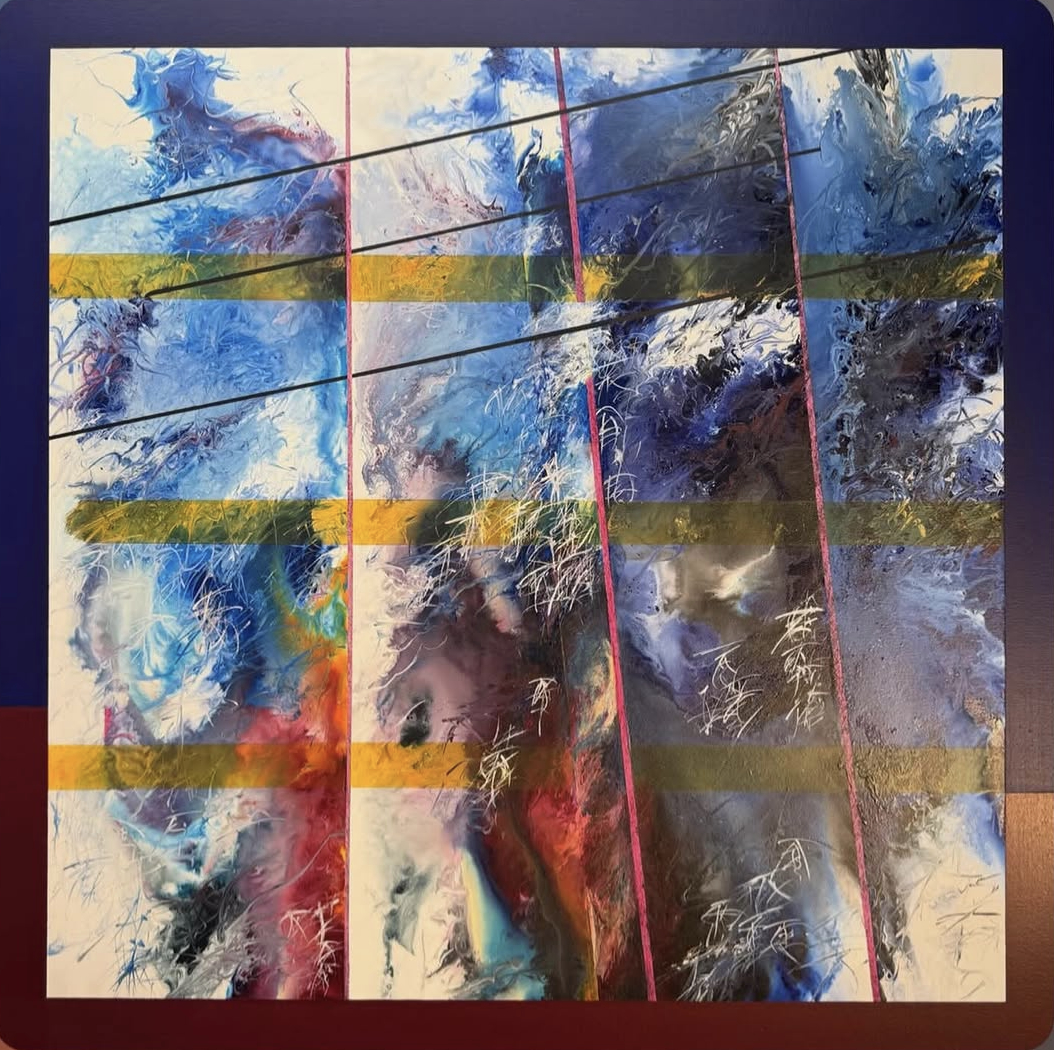
It’s There in the Humming Air, Bill Santelli
Over the past few years, Bill Santelli has been building his magnum opus, a series he calls It’s There in the Humming Air, a name I love because it suggests the way it feels when, as a child you are outdoors in the summer and everything is buzzing and fragrant and you are free to do nothing but play and you are so absorbed by what you are doing you forget you exist. Which also describes being in a state of flow as a painter. In other words, the world becomes a Wordsworthian heaven. For Santelli, this state of unity with a universe that’s utterly alive doesn’t need to happen out of doors. He just needs the window of his square, gridded canvases to get a glimpse of it inside himself. One of his most recent pieces in this series was shown in the Butler Institute’s Midyear Exhibition this summer, as it deserved to be. Paul Jenkins is a huge influence on Santelli and Butler holds a special reverence for Jenkins. These improvisations in chromatically intense color never look gaudy or jarring, despite the level of saturation in purples or blues or reds. Everything is offset with and tempered by the white, and the delicacy of the almost fractal complexity of the paint’s properties as it settles on the canvas. When he was young Santelli was riveted by Pollock, and though he doesn’t fling dripping paint at the surface, it doesn’t just sit still once it arrives. He constantly nudges and guides the still wet acrylic, getting the organic edges to echo what’s going on in the whole painting. In many of these, he’ll withhold a particular part of the spectrum and then just give the viewer a hint or taste of it in one discreet spot, as he does here with the blue that almost becomes green in the lower left just under the middle of the painting. That one little shift in tone enlivens everything else in the painting. These meditative, liminal images are a masterful exploration of color and form within very tightly defined personal formal conventions that carry through the entire series, making the differences from painting to painting even more dramatic and satisfying. I’m not sure how many Santelli has finished; I think it was around eighteen of these the last time I asked. I’m sure it won’t be enough.