October 23rd, 2026 by dave dorsey
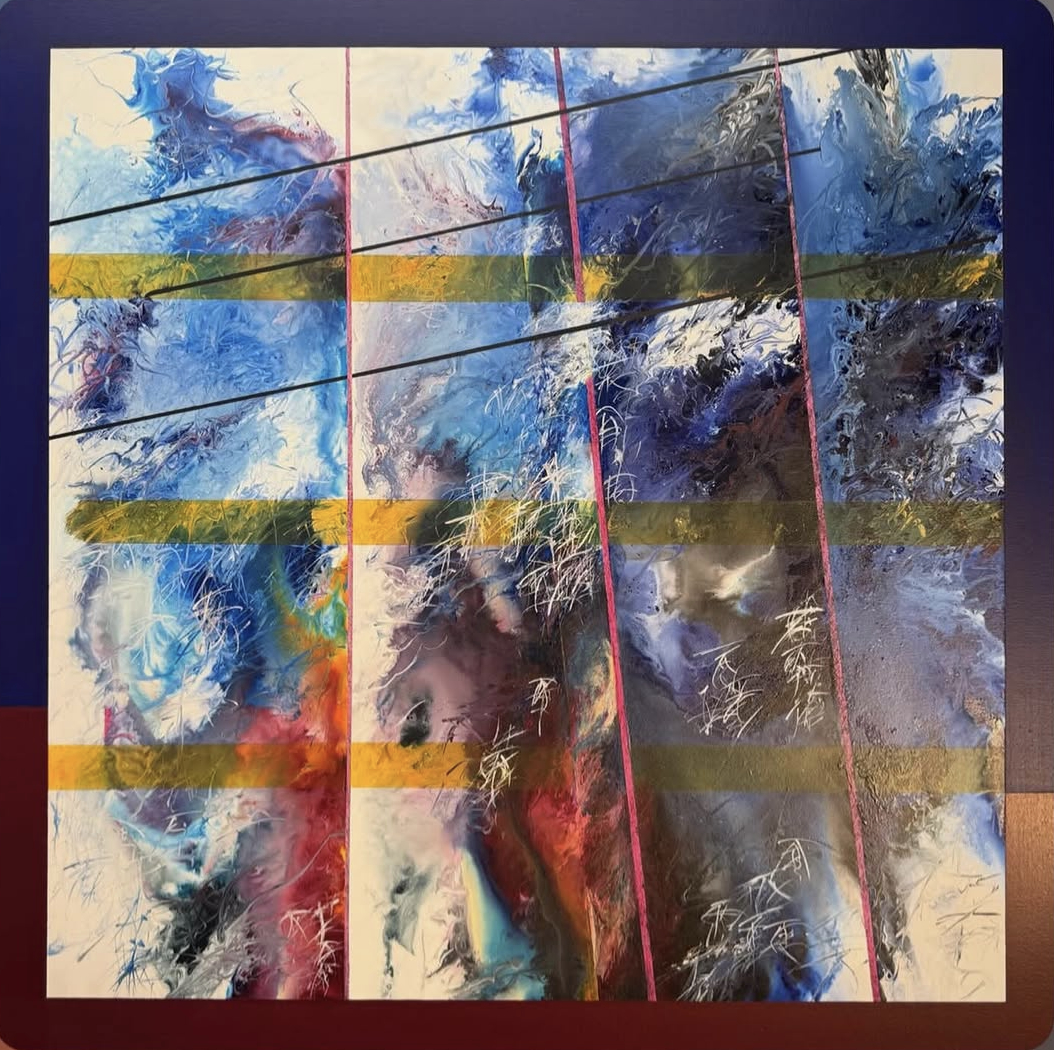
It’s There in the Humming Air, Bill Santelli
Over the past few years, Bill Santelli has been building his magnum opus, a series he calls It’s There in the Humming Air, a name I love because it suggests the way it feels when, as a child you are outdoors in the summer and everything is buzzing and fragrant and you are free to do nothing but play and you are so absorbed by what you are doing you forget you exist. Which also describes being in a state of flow as a painter. In other words, the world becomes a Wordsworthian heaven. For Santelli, this state of unity with a universe that’s utterly alive doesn’t need to happen out of doors. He just needs the window of his square, gridded canvases to get a glimpse of it inside himself. One of his most recent pieces in this series was shown in the Butler Institute’s Midyear Exhibition this summer, as it deserved to be. Paul Jenkins is a huge influence on Santelli and Butler holds a special reverence for Jenkins. These improvisations in chromatically intense color never look gaudy or jarring, despite the level of saturation in purples or blues or reds. Everything is offset with and tempered by the white, and the delicacy of the almost fractal complexity of the paint’s properties as it settles on the canvas. When he was young Santelli was riveted by Pollock, and though he doesn’t fling dripping paint at the surface, it doesn’t just sit still once it arrives. He constantly nudges and guides the still wet acrylic, getting the organic edges to echo what’s going on in the whole painting. In many of these, he’ll withhold a particular part of the spectrum and then just give the viewer a hint or taste of it in one discreet spot, as he does here with the blue that almost becomes green in the lower left just under the middle of the painting. That one little shift in tone enlivens everything else in the painting. These meditative, liminal images are a masterful exploration of color and form within very tightly defined personal formal conventions that carry through the entire series, making the differences from painting to painting even more dramatic and satisfying. I’m not sure how many Santelli has finished; I think it was around eighteen of these the last time I asked. I’m sure it won’t be enough.
October 21st, 2026 by dave dorsey
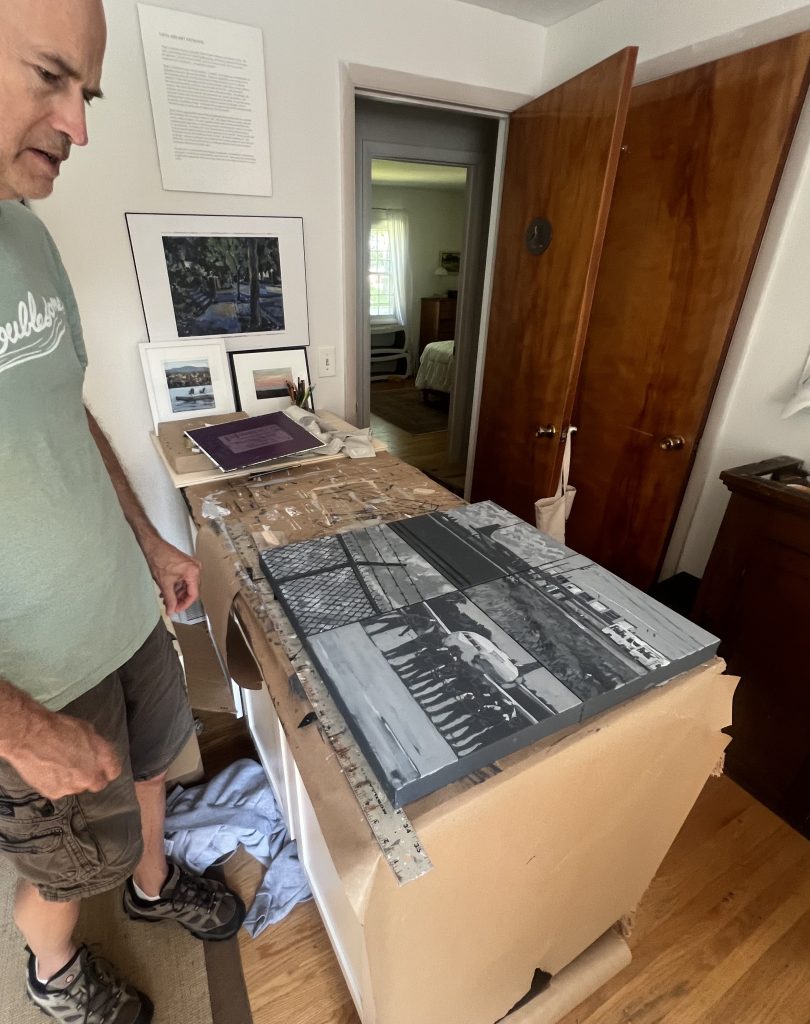
Jim Mott in his studio with four of the paintings for the RoCo show.
Jim Mott is showing some new work in RoCo’s exhibition about immigrant experience: Sanctuary/Borders and Belonging in 2026. It’s a bit of a departure for Mott. Though he’s been on the left politically most of his life, he has had reservations not only about much of what the far left has embraced in recent years, he’s also rarely been overtly political in his work. There have been subtle exceptions when, for example, he travelled to Ferguson, MO, on one of his itinerant painting journeys. His paintings of the place didn’t directly depict the social unrest or the shooting death. He has approached the subject of immigration, borders, and ICE in the same sidelong way. As with his in situ work from the past, in order to paint the places he chose, he made every effort to physically travel to the locations in New York State where captured immigrants have been detained and processed. Occasionally he had to rely on existing photography.
I was impressed with everything about the imagery he created. All of his contributions to the show were done strictly in a grisaille scheme of white, grey and black gesso. He doesn’t even get to the stage of painting with acrylic or oil. His palette matches the colors appropriate at a funeral. The mood is somber and the world looks as colorless as it does for someone suffering from depression, and yet these are some of the most accurately vivid and confident pieces he has painted—with a feel of vibrant immediacy. He constantly uses the geometry available in the photography he took to build a structure that lends power to the groupings. Some look pleasantly unfinished and elliptical: you almost aren’t sure about what’s being shown, but it lends to the intrigue of his entire approach: something sad is happening somewhere but where is it?
The paintings are all in uniformly sized, square formats, with four square images merged together to form a larger square. Each smaller painting is complete in itself, and there’s nothing continuous running from one smaller image into its neighbors, as there often is for painters who attach canvases for a diptych or triptych. Yet there’s a unity of light and mood that carries through all the assemblages. Many convey a very realistic quality of light at a certain time of day and season. Each larger square feels like a split-screen in a movie, showing various things happening in different places at the same time, yet often what’s happening in each vignette happens to be extremely undramatic, even static. The placard for a restaurant near a detention center. A close up of an insignia on a federal building. The Rochester, NY skyline near the river (not far from the federal building.) A grid of chain link fence. Each image reminds one of a short Imagist poem or that line from W.H. Auden’s poem about Bruegel’s Icarus:
…how everything turns away
Quite leisurely from the disaster; the ploughman may
Have heard the splash, the forsaken cry,
But for him it was not an important failure; the sun shone
As it had to on the white legs disappearing into the green
Water; and the expensive delicate ship that must have seen
Something amazing, a boy falling out of the sky,
Had somewhere to get to and sailed calmly on.
October 19th, 2026 by dave dorsey
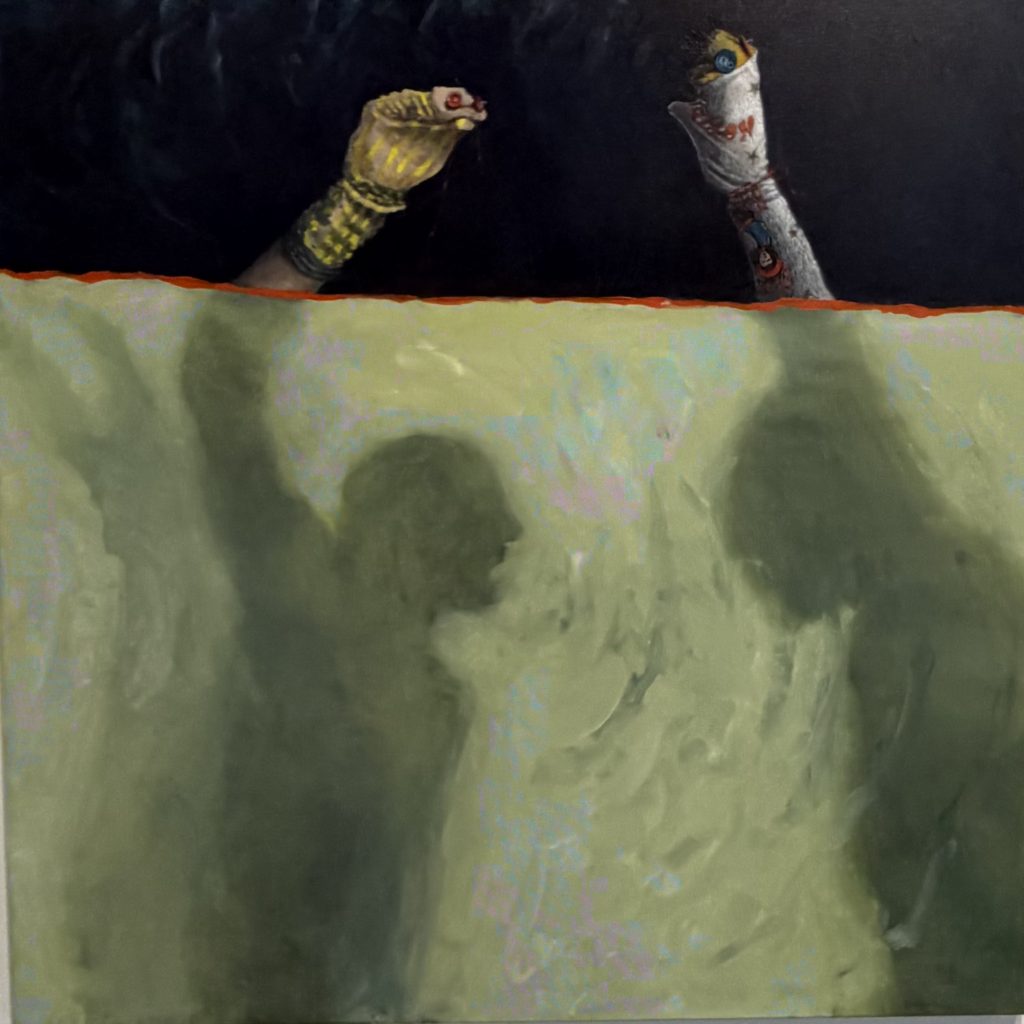
Howdy, one of Amy McLaren’s sock puppet paintings, RIT City Art Space
Amy McLaren’s Puppet Show at RIT Art Space is anything but cute. At first glance, it might be mistaken for an adjunct to the Strong Museum of Play across the street. Well, there are a lot of sock puppets on display. Yet in her paintings of them, the puppets are a bit more like rearing cobras than soft wooly playthings. Puppet Show is a quietly understated and intelligent installation of her most recent narrative paintings and drawings using sock puppets as the embodiment of our current plague of online cussedness. (And offline, if you pay attention to the men and women behind the curtain.) It’s the perfect word for the idiocy behind most online flame wars between one side of an issue and another: an addiction to being right and making others wrong. An addiction to a set of ideas about the world and the people in it, and all the conflict that follows from that. All of it prosecuted behind a mask of online anonymity or at least the safe distance of virtual space. Slip that sock puppet on and you’re free to say anything nasty: boom, own that opponent! Nothing is accomplished. Nothing has changed. The temperature of the culture just notches up imperceptibly. But the armor of the worldview that drives all the chatter is just as much a mask. The wearer simply forgets that this is the case. No one really knows anything, as Socrates observed about himself, but we all behave as if we have cornered the market on The Truth.
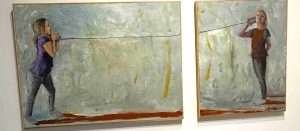 What has always made McLaren’s paintings so endearing is that, while she depicts something serious, she makes it slightly amusing. It’s unpretentious and amiable, but it comes from a kind of sorrow at human frailty. Hence her disappointment when someone thinks the sock puppets are cute. She has the facility, the gift, in a different way, that Daumier and Norman Rockwell had: the ability to vividly convey the inner life of human beings through faces and body language. Her previous work displayed this gift in generous ways: everything was in medias res, a freeze frame of people in opposition, bodies in motion, faces full of passion and struggle. Some of the large drawings she did for this solo show prove that she can pull this off spontaneously, once-and-done, with paint sticks, drawing figures that look as if they’ll move when you turn away.
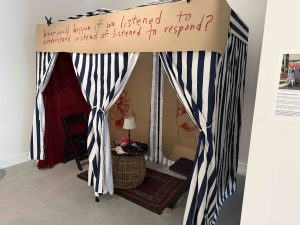 The centerpiece of her installation is a little striped tent pitched in one corner, with a table and lamp, and some sock puppets on the table. It has a “It Happened One Night” curtain two people can pull between them, sitting in opposite chairs (after picking a question to discuss out of a bowl.) Then, to speak, one of the interlocutors sticks a sock puppet around the edge of the curtain to make whatever remarks are inspired by the question. It’s absurd, because there’s no anonymity, but it does add a meta- quality to the conversation that makes the speaker think of whatever he’s having his avatar say almost as a third person. It adds a level of self-observation. The whole little stage for this forces the participants to observe the dynamics of talking with someone else through the illusory safety of the curtain and the knitted representative on one’s hand. The set-up makes online anonymity physical and silly and self-conscious. In the tent you know there’s another human being over there, listening. So you listen to yourself. And that’s the whole point: to listen. McLaren has stretched a banner across the front of the tent: “What would happen if we listened to understand instead of listening to respond?”
It’s a wonderful premise for a solo show, and McClaren fulfills the premise in a lovely, understated way.