July 8th, 2011 by dave dorsey
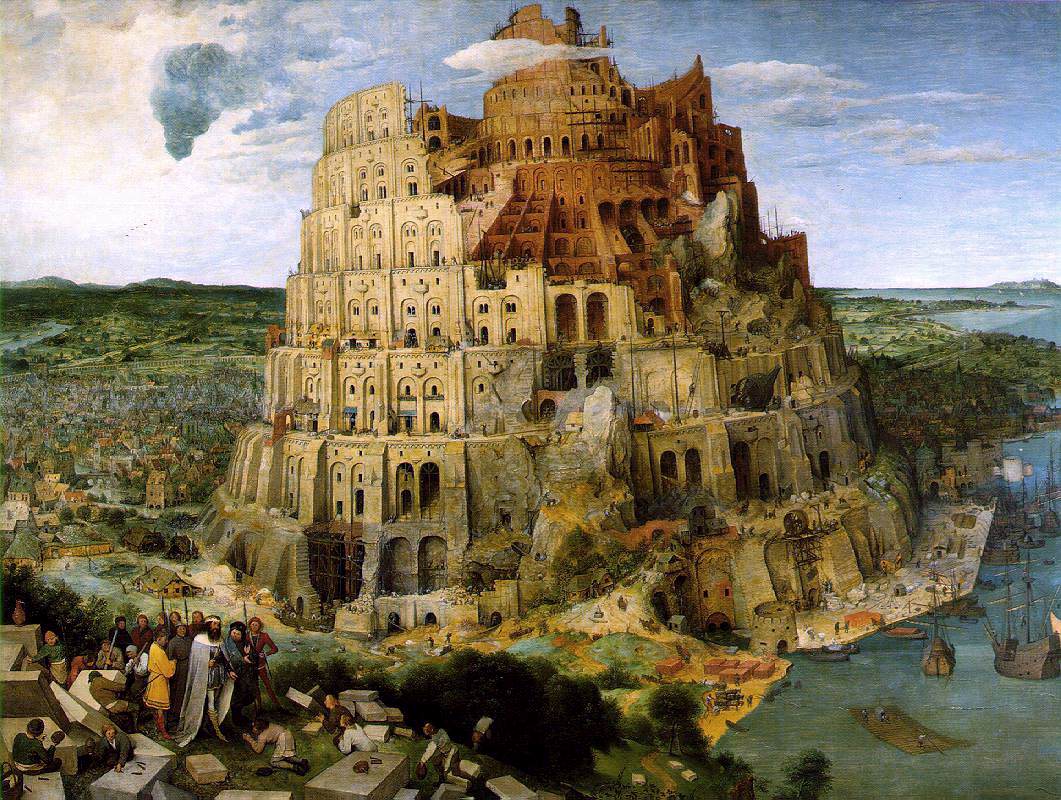
Brueghel's Tower of Babel
Gazing at a great painting for the first time feels a lot like introducing myself to someone fascinating and a little mysterious. Actually, that’s exactly what’s going on. In a sense, I’m becoming friends with the person who created it, and a great painting conceals and reveals itself, as an object of appreciation and understanding, the way its creator would. And what you “learn” from it is analogous to what you learn by becoming friends with someone. It’s more complicated than “knowing.” If the painter has managed to subconsciously fuse his or her life into the work—in other words, insofar as it’s actually a work of art—the painting becomes a portal into who that person is. What it literally represents is beside the point. If the work’s purpose is to illustrate some conscious notion the artist holds—the sordid and oppressive nature of the male gaze, the hegemony of European culture over the Southern hemisphere, the emptiness of celebrity, what have you—it will do what it was meant to do, if it’s good. But it won’t be doing what painting is uniquely qualified to do. Once you get the message, why look twice? More
July 7th, 2011 by dave dorsey

How many words does it require to support an intellectually contrived image? I own The Cremaster Cycle. It’s a cinder block of a book, full of Masonic mystification. In a way, it’s the ultimate Artist’s Statement. I haven’t read a page of it. And I haven’t looked much at the pictures either. My fondest memory of the Matthew Barney show at the Guggenheim (my most unpleasant memory is of buying this enormous book devoted to the show and then straining my lower back by lugging it up along Fifth Avenue) was spotting Isabella Rosselini on one of the upper floors, without makeup, keeping it real by looking really depressed and lost. Some things you can understand only in their context, and that look on her face was one of them. It was the look on my face too.
July 7th, 2011 by dave dorsey
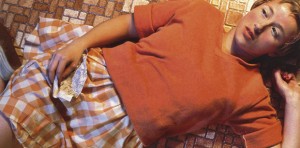
The money shot
Recently, I heard from my friend, Sancho Panza, in Tennessee. (I love Tennessee because it’s hilly and beautiful and because Nick Blosser paints there. But I digress.) Sancho doubts. He mocks. He finds me amusing and occasionally annoying and generally thinks I live in a world of fantasy. Sometimes, he addresses the level of truthiness in my thinking. Other times, he’s dead wrong about whatever, but when it comes to the realm of art it’s refreshing to hear from him. He’s a sort of bollocks alarm. When something looks fraudulent in a groupthinky way, as it often does, in the empire of art, he just comes right out and asks “Who cut the Moose House cheese?” He spotted this item from Popular Photography and proceeded to ask why:
Cindy Sherman’s “Untitled #96″ from 1981 has become the world’s most valuable photograph after selling for a staggering $3.89 million at a Christie’s auction yesterday (it was estimated to be worth up to $2 million). The winning bidder was Philippe Segalot, a private advisor to some of the world’s wealthiest art collectors. The photo takes the top spot away from “99 Cent II Diptychon” by Andreas Gursky, which enjoyed five years as the world’s most valuable photo after selling for $3.35 million back in 2006.
Me: Yes, the auctions are hitting new highs. The bubble continues. She’s an interesting character.
Sancho: How do you explain what the bubble chooses?
Me: She’s been around for decades. She’s “established.”
Sancho: But then they randomly settle on one piece of work? This is what strikes the outsider as nuts. More
July 6th, 2011 by dave dorsey
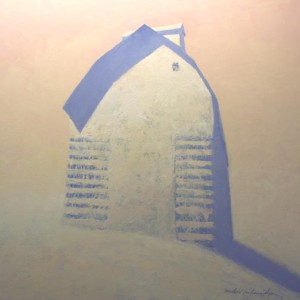
from the Barns collection
If I step back and just observe myself while I paint what I notice is pretty simple—and extremely simple-minded. I become less and less conscious of myself and what I want my activity to mean and far more aware of the feel of what I’m doing. When I know, with the entirely subjective certainty of someone in love, (translate: deaf and blind to the opinions of others) that everything I’m doing is exactly right, a number of conditions hold up. I’m aware of having established a set of personal rules, which I’m following at a steady, rhythmic pace, not too fast, not too slow—the quality of the brushwork, the thickness of the paint, how closely I maintain crisply defined edges and outlines, exactly what colors I will and won’t use, and what kind of sheen I expect the paint to have when I’m finished—slightly matte, not reflective, no shine at all, seemingly as soft as the cloth that supports it.
I might be the only person in the world who cares about these things, ever, but the strange thing about painting well is that these factors become all-important. I’m never focused on what the painting has to say, or what it “means,” or how “significant” it needs to be. All of these variables would appear entirely arbitrary to anyone else, but for me they become an absolute necessity. My Ten Commandments. My Noble Truths. My Rules of Order. Whatever. Once I start swerving away from those personal guidelines, and that steady Dr. Dre tempo they impose on my work, those minute particulars and private measures of excellence, there’s no going back—it’s all More
July 6th, 2011 by dave dorsey
represent
— to present an image of something through the medium of a picture
— to bring clearly before the mind
— to set forth in words; state or explain
— to have the nerve to speak for others of your group