Hirst
February 19th, 2014 by dave dorsey
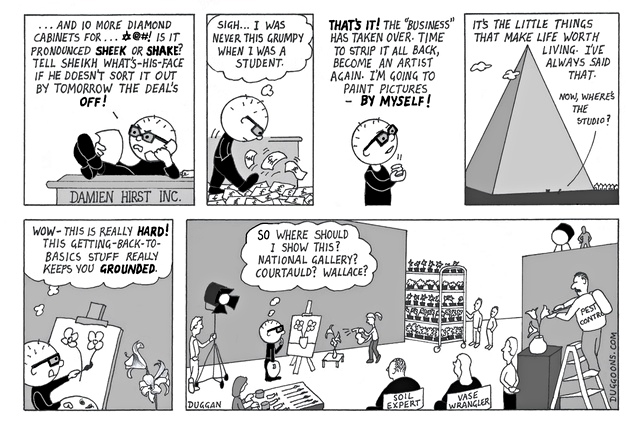
Damien Hirst at the drawing board
Damien Hirst keeping it real at The Guardian. Any openings for “vase wrangler?” I have experience.
the painting life
Damien Hirst at the drawing board
Damien Hirst keeping it real at The Guardian. Any openings for “vase wrangler?” I have experience.

On my cousin Brian’s advice, I bought a used DVD of this documentary from Amazon for $10. I was a paperboy once, in Boise, and I remember the needle-nosed pliers I brought to the streetcorner where my manager dropped a bale of papers at 4 a.m. I used the pliers to snap the wires around the stack of Idaho Statesmans, folded them and stuffed them into my bag, the set off down Irving Street in the dark. I think I had maybe 60 subscribers on my route. The worst part was collecting for the month’s subscription, with my little perforated tablet of receipts, knocking on doors and having people hand me cash in exchange for a little ticket I ripped from the top sheet. No, wait, the worst part was when our manager tried to turn us into salesmen and drove us down into the valley knocking on doors in the less privileged neighborhoods, asking people to sign up for the newspaper. I really hated that. There was no Internet, of course; it was long before computers, back when I kept a collection of 45 rpm hit singles, with the big hole in the middle requiring the plastic adapter for the turntable spindle, songs like Red Rubber Ball and Black is Black and Sloop John B. But I digress . . .
The point is, this film is directed by a graphic designer who did “groundbreaking collaborative design for Beck, Beastie Boys and Sonic Youth.” It came out sixteen years ago or so, back in the heyday of the first (or was it second) bubble, better known then as the dot.com boom. Oh, those were the days, when the economy at least appeared to be strong. He says:
I wanted to see if these kids were aware that they are part of a long tradition. Were they aware of how they were also changing that tradition? While doing this film I was excited to see how the almost Norman Rockwell image of the paperboy blended in with the contemporary Eminem-influenced teenage boy. This hybrid of contemporary television/rap oriented teen and American icon of “the good old days” is so full of contradictions that happily live together.
Our Democrat and Chronicle, here in Pittsford, is delivered by an adult in a car, who comes around as early as my manager did in Idaho. He’s diligent and industrious. We pay by mail. I miss the kids on their bikes. It’s consolation that the Girl Scouts still knock gently on our door, offering to put our name on their list for cookies. Some traditions endure.
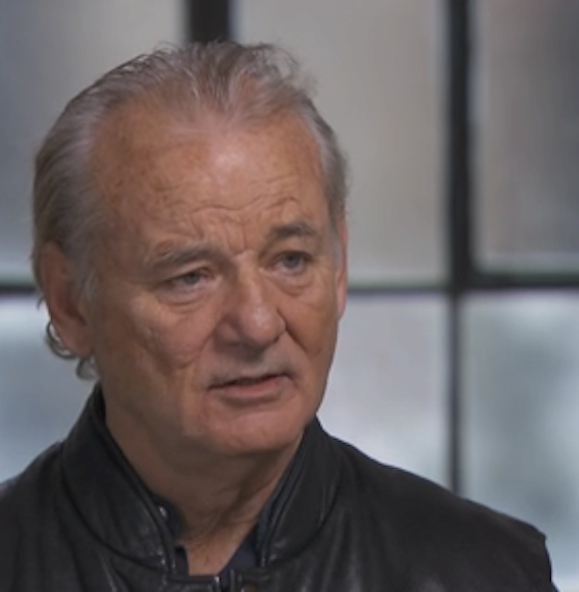
Bill, on Artists in Berlin
Bill Murray to Charlie Rose on Berlin as an artists’ colony: “Berlin is a bubbling place. It’s an artists’ colony. Sort of like Austin, Texas. All the artists of Europe flock there because it’s relatively inexpensive. People live like socialists sort of; there are the squatters. I know an American guy, he was a socialist here, he went to Berlin and he rents his little place and squats somewhere else. I would think Berlin would be a wreck, but what they didn’t bomb is completely intact. On the East German side nothing is changed.”
It almost sounds as if parts of Berlin have been awaiting a renovation since WW II: where people can just squat and live for free. Hm, if it’s either Detroit or Berlin, is there really a choice?
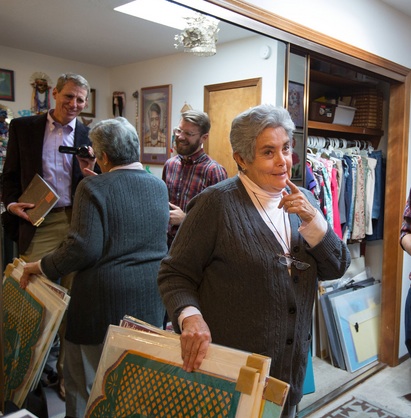
Catalina Delgado-Trunk, an undiscovered artist visited by Alice Walton’s scouts
If somebody knocks this year, answer the door. Alice Walton is sponsoring a search for unknown, unrepresented talent for a show meant to be her challenge to the Whitney Biennial and the art-world dominance of New York and Los Angeles. Her team ranks each prospective artist on three scales: engagement, virtuosity, and appeal. Refreshingly simple. Says the Times, “They are already logged 50,000 miles visiting 500 artists in 30 states, and they had almost 500 more to go.”

I’m donating 15 percent of any sales to the Empty Bowls project.
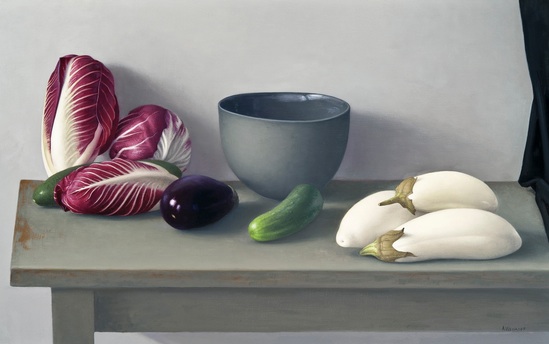
Still Life with White Eggplant and Radicchio, Amy Weiskopf
“FOUNDED IN NEW YORK CITY in 1994, Zeuxis began as an association of painters exploring the possibilities of still life—traditionally the least prestigious of genres—in the post-Modernist art world.”
— Zeuxis
Fellow Oxford Gallery artist, Matt Klos, will be included in an exhibition at First Street Gallery of still life paintings around the theme of “blue.” He has a three-artist show coming up at Oxford next month as well.
From the email announcement: FIRST STREET GALLERY is pleased to present a group exhibition by Zeuxis, An Association of Still Life Painters.
“Painters compose with color the way composers paint with notes; one form builds in space, the other in time… And here is something else music and painting have in common: both can sing the blues.”
Any self-respecting still life, of course, is never still in the sense of being static. Its colors shift, push and build: a blue can be icy or mild, bracing or elusive. The challenge set by Zeuxis for the artists in Still, Blue is to investigate a particular blue, and from its character develop an entire painting.
Since 1995 Zeuxis, an association of still life painters, has organized dozens of group shows in New York City and around the country. Its exhibitions have been reviewed by The New York Times, The New York Sun, The Hudson Review, The Philadelphia Inquirer, and many other publications. The 31 participants in “Still, Blue” include, in addition to the artists of Zeuxis, guests Sallie Benton, Matt Klos, Carol Stewart, Benny Fountain, Catherine Maize, Stephanie Rauschenbusch, and Sheldon Tapley.
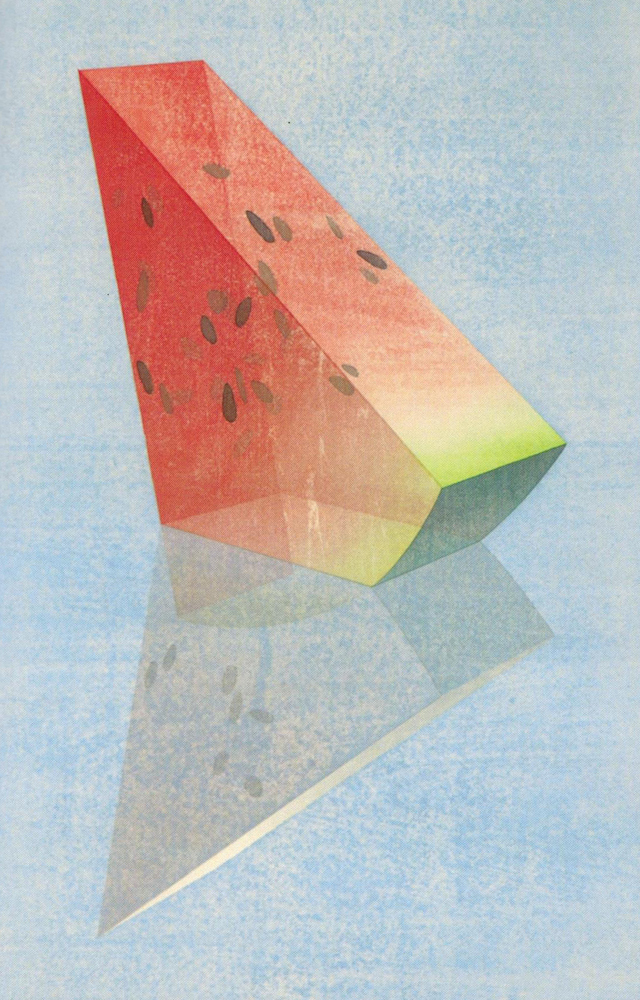
Surfacing Watermelon, Shoji Miyamoto, Japanese woodblock
A fantastic show of work from 13 contemporary Japanese artists, at the Memorial Art Gallery, stuck me as a thrilling demonstration of how an obsessive focus on something as impersonal as method can generate original, idiosyncratic work that’s emotionally powerful and wonderfully expressive. I’ve been working on work for a small solo show in June at Viridian Artists, built loosely and maybe a bit whimsically around the idea of polarity, so I was primed to be dazzled by what I saw here. All the work here levitates in the mind, lofted by the magnetic poles of opposing forces: the abstract work hints beautifully at representation and the most representational work hews faithfully to narrow formal constraints. The rigor of technique disciplines, unobstreperously and almost politely, intense personal passions: you can feel the Japanese adherence to self-effacement in the strictures these artists have applied to what they do, and yet, at the same time, these self-imposed boundaries seem to heighten the passion. It’s like watching The Age of Innocence, start to finish, in a single glance. What you end up with is highly refined mastery, and remarkably some of these artists appear to be only a few years into their careers.
Curated by Sam Yates, of the Ewing Gallery of Art and Architecture, with a MORE

The third floor of Rod Stewart’s Los Angeles home contains a model railroad layout that measures 23 X 124 feet, and he estimates that he has at least another three years before it’s complete. Is it a work of art? In the Daily Beast, Malcolm Jones thoughtfully suggests that maybe it is. In a world where a diorama counts as art, why not? It’s a miniature representation of some part of the world, in three dimensions, after all. There’s a passage in the piece that makes me want to agree:
I laughed when saw the story. And then I began reading about the depth and breadth of his zeal (he has two assistants, he rents an extra hotel room on the road when he’s performing for designing, building, and painting the structures that populate his layout). Then I studied the photographs in the magazine closer—and the more I looked, the more impressed I became. The attention to detail, coupled with carpentry skills and a painter’s eye (he’s colorblind and someone has to check his reds and greens, but still), strongly suggest that here is an artist—a nutty artist, maybe, but an artist.
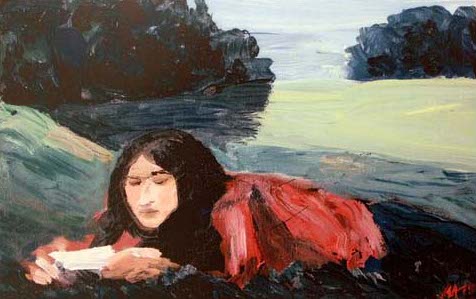
The Letter, Henry Coupe, oil on linen, 10×16
Henry Coupe, one of the most recent new members at Viridian Artists, has finished his career as an artist, but I hope his reputation has only begun to gain momentum. All his life, he struggled with various degrees of vision impairment, and yet he lived for painting. He deserves a lot more attention than he got while he was actually creating art, and if I had the money to be a collector I’d be grabbing a room full of his canvases right now. His work, mostly very small, does exactly what much of my favorite painting invariably does: it calls my attention to the quality of the paint itself, purely as paint, while it evokes something that takes me away from the medium and into a dream. That polar struggle between the physical reality of a canvas and what it fools you into seeing is at the heart of why painting matters, for me–and Coupe also has a sense of color that’s both somberly beautiful, but somehow also conveys solitude, isolation and yearning. He studied in Utica with a student of Hans Hofmann, where he grew up and lived all his life, and his work shows not just his love of expressionists like Kirchner, but, like Hofmann, a strong sense for simplifying areas of pure color, composed with an eye to the abstract pattern he assembles on the surface. His sense for color is akin to what Louisa Matthiasdottir–who studied directly with Hofmann–achieved in her brilliantly simplified scenes of Iceland, which are as colorfully intense as a Hodgkins canvas. Coupe’s color can be just as evocative as hers, but in ways it’s more elusive and mournful, submerged in an aura of darkness from which his figures always struggle to emerge.
I stopped in Utica to meet his wife, Ann, a while ago and spent the MORE
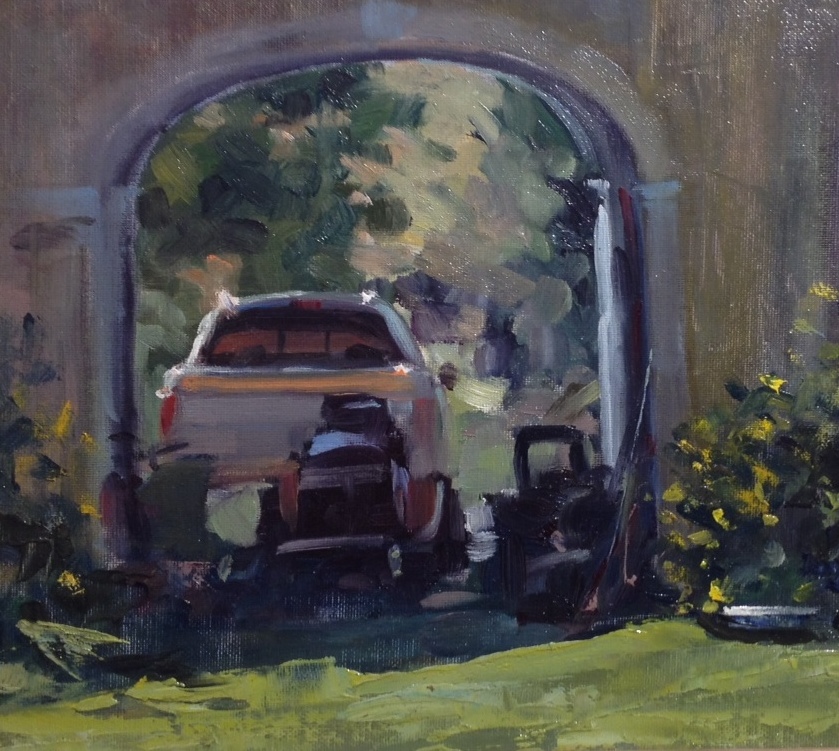
Breezeway, Ray Hassard
My favorite painting in the current two-person show at Oxford Gallery, looks both effortless and masterful. I love the way the pickup’s two tail lights vary in terms of the color’s saturation, which somehow looks entirely realistic and yet may just be an artifact of Hassard’s confident brushwork. Or the sun is hitting one directly and not the other. I’m guessing that’s a riding lawnmower in the foreground, shaded, under the arch, but it doesn’t matter what it is. Identifiable or not, it’s perfect. He’s one of the best pastel artists in the country, and most of the work on exhibit here is pastel, but he’s just as good with oil. Also in the show are Patricia Tribestone’s intensely colorful still lifes. Coming next month to Oxford: two artists I love in a three-man show: Rick Harrington and Matt Klos.

Billy, the Magical Dog, in Los Angeles
This is an interesting Boston Review article that not only buries the lede, but obscures its thesis a bit by talking in circles around it. The core of it is the notion that dogs can teach us to eliminate the boundary between physical and mental through a different order of attentiveness and “obedience” to what’s actually happening around them. In other words, dogs are models of mindfulness–which never gets said in quite that way. The easier and more attention-getting point it keeps making is that dogs aren’t people–since most of us mistakenly treat them as if they were. By anthropomorphizing them, we diminish their greatest virtues and so on. The real point of the article is that people aren’t canine enough. People should strive to be more like dogs:
Dogs live on the track between the mental and the physical and seem to tease out a near-mystical disintegration of the bounds between them. Their knowing has everything to do with perception, an unprecedented attentiveness that unleashes another kind of intelligibility beyond the world of the human.
Unleashes. (That must have been too tough to resist.) “Another kind of intelligibility” comes and goes here, but that phrase made me stop and smile. “A knowing that has everything to do with perception,” not reasoning or conceptual thought, is what, for me, painting is all about. The ideas, the concepts, the implications of a painting beyond what perception alone conveys (and the point in this article is that perception alone can convey a world of immediate understanding and reaction that doesn’t require thought) these chimera can attach themselves after the fact, even with a purely perceptual painting, yet for me that’s the proper order. First the painting; then the idea. I’d like to think that Duchamp’s Fountain happened at the moment when he found himself involuntarily admiring the curving forms of a urinal, despite himself, and then probably realizing that a sculptor could have made it, and exhibited it, and then . . . well, Pop art followed with all of its preconceived ironies and poses, generating the flood of work it has produced. Yet it began with a simple perception, an awareness of how difficult it can be to differentiate between life and art. And even that thought was after the fact of the simple perception of beauty in the forms of something Duchamp was conditioned (by thought) to see as nearly the exact opposite of art, the lowest object imaginable, because he knew its purpose. So he turned his perception into a highbrow joke. It really is a fountain, and the more you think of it as a fountain, the more laughs you’ll get out of Duchamp’s humor, yet the more you think, the further you get from the original, unsullied perception of the formal qualities in that porcelain object that set in motion the whole notion of exhibiting a urinal. What has bothered me about art, at least since Duchamp, is how perception, which is the heart of visual art, has so often been subordinated to the ideas that arise around it, or that, at its worst, art becomes merely an illustration for an idea, a visualization of a thought. The ideas should be at the end of the process of struggling with the formal challenges of a medium, not at the start, in my humble opinion. It’s the pursuit of “another kind of intelligibility” unavailable to the calculating, reasoning mind: Duchamp had that at the moment he paused to keep looking at the urinal . . . and then his calculating mind took over and we’re back in the world of commonplace intelligibility, and a “stance” about art and the art world in general, implied in the humor and scandal of exhibiting a urinal as a work of art.
Painting can dissolve the boundary between mental and physical and produce, as it happens, a different kind of exuberance about life that has everything to do with having more awareness than opinions about it. So, all of this only confirms what my wife has often thought: yes, I’m a dog.
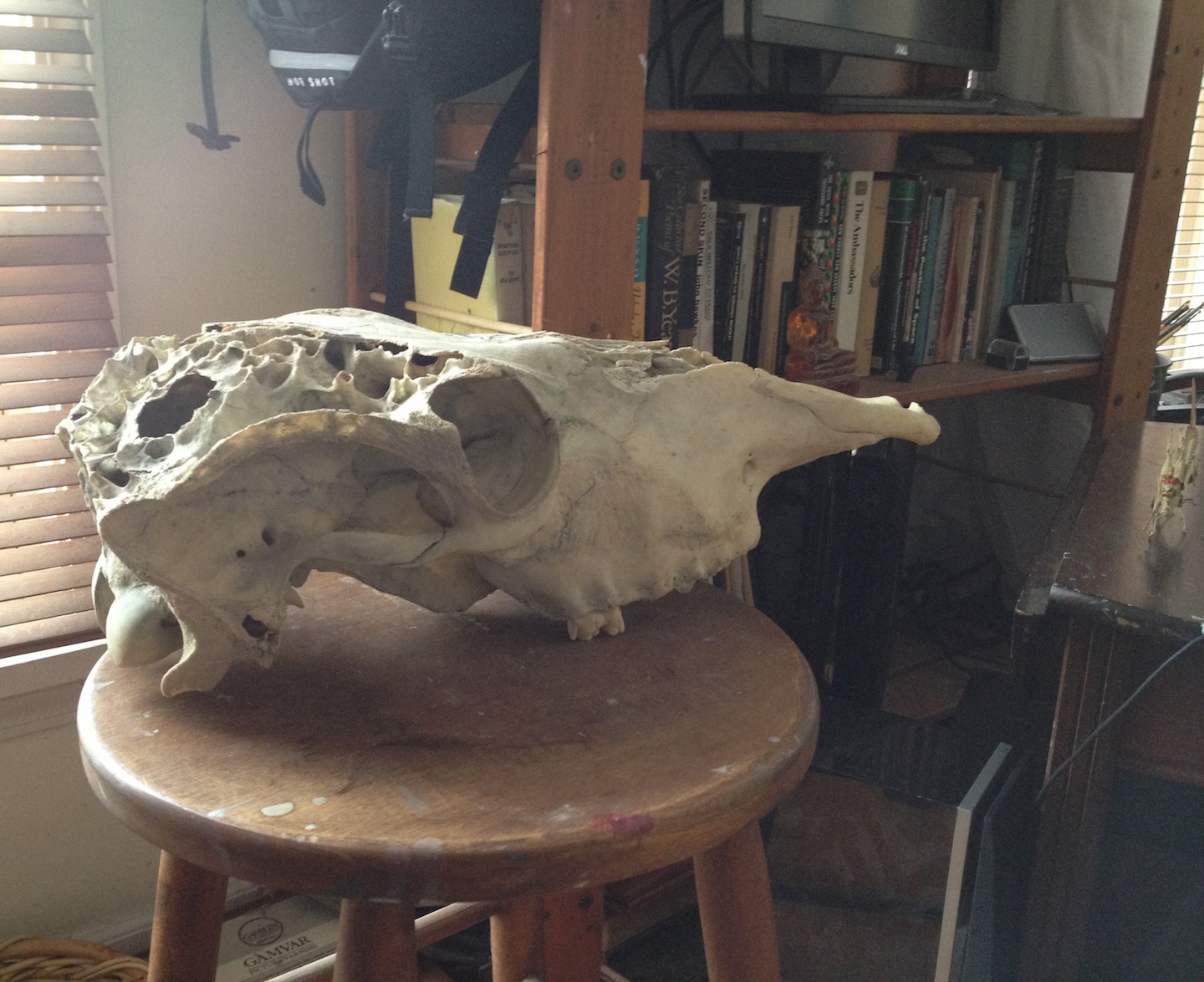
My cow skull
A little Zen pun up above to brighten your day. Every morning in my studio, this cow skull that Susan Sills kindly gave me, sits on that stool and doesn’t actually say Mu, like Joshu, but it does whisper tempis fugit. Always showing off its Latin. I just say, thanks Boss. (Which is close enough to the Latin for “cow.” Bos.) I know all about it at my age. Time flies. But I get more painting done when I’m reminded.
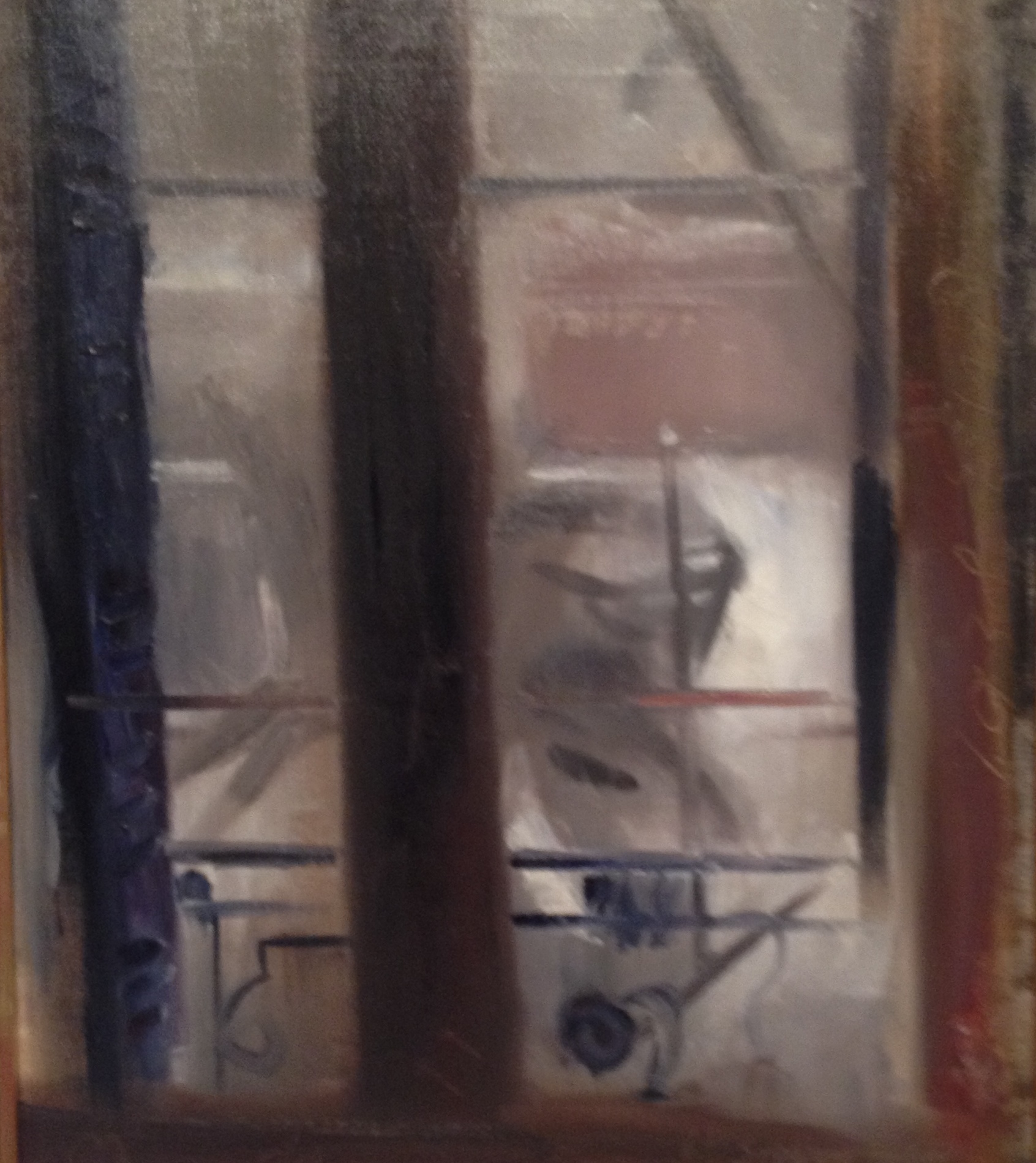
Edwin Dickinson, Snow on Quai, Memorial Art Gallery
One of Dickinson’s premier coup paintings, an exhilarating find for me, at the Memorial Art Gallery, where I took this shot yesterday.
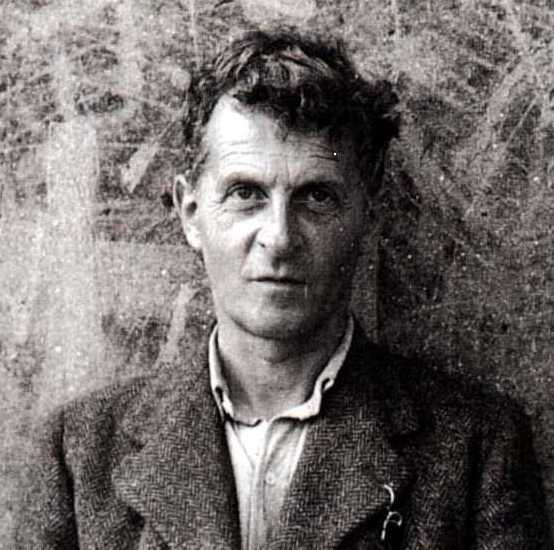
Art can show you what’s right there in front of you, but you don’t really see it, you aren’t fully aware of it, until art represents it. This passage from Wittgenstein is confusingly worded, but I’m sure he meant “imagine a curtain goes up and you see yourself, walking up and down, lighting a cigarette, sitting down. . . ”
Let us imagine a theatre; the curtain goes up and we see a man alone in a room, walking up and down, lighting a cigarette, sitting down, etc. so that suddenly we are observing a human being from outside in a way that ordinarily we can never observe ourselves; it would be like watching a chapter of a biography with our own eyes — surely this would be uncanny and wonderful at the same time. We should be observing something more wonderful than anything a playwright could arrange to be acted or spoken on the stage: life itself.
But then we do see this every day without its making the slightest impression on us!
–Wittgenstein
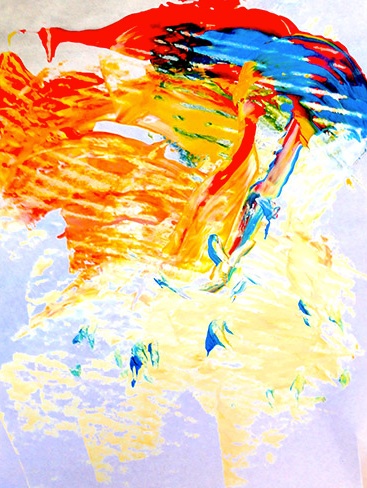
Self, Valerii Klymchuk
In the current solo show at Viridian Artists, you can get a sample of work from one of our youngest members, who immigrated from Russia only a few years ago: Valerii Klymchuk. Many of his images make me wonder if he believes, as Heraclitus did, that the world is made of fire, and his sense of color is intense, personal and lyrical. He’s a brilliant young man, who got into a program at Columbia University to study big data, but couldn’t afford the tuition. He has the look of a young man out of a Dostoevsky novel, or one of those contemporary Russian Orthodox monks in the book Everyday Saints. Maybe if he sells one or two paintings, at the prices he’s asking, which have always made me smile, he can get his coursework done at Columbia. He has a bit of that Warhol impishness about him: half the time, I can’t tell if he’s putting us on or if he’s dead serious, but in these answers there’s very little irony. He hasn’t been painting long, but he has a kind of courage to do anything that occurs to him, in his work, that would rarely occur to a career-minded painter as an option these days. I sent him a few questions, and rather than try to filter his thinking, I’m passing most of it along as he sent it to me. He sounds Russian, even in his writing:
You took up painting without studying it in school right?
I just started doing art without any previous studying. It happened spontaneously, during one of the hardest periods of my life when I was desperate to find meaning in my life, struggling to find my own place in this world. I was introduced to painting by a friend in New Jersey. He hosts painting sessions at his house, where he and his friends sit down on the floor painting.
Before that day, I never considered myself an artist, and I never thought I had artistic talent. Just the opposite—I thought that I had no talent in painting whatsoever. My sister could paint, and I knew that I was good in mathematics and sciences, but I thought that painting was something absolutely foreign to me. I never had any tendencies to express myself in painting before.
Only when I painted for the first time at my friend’s house . . . was I surprised to MORE
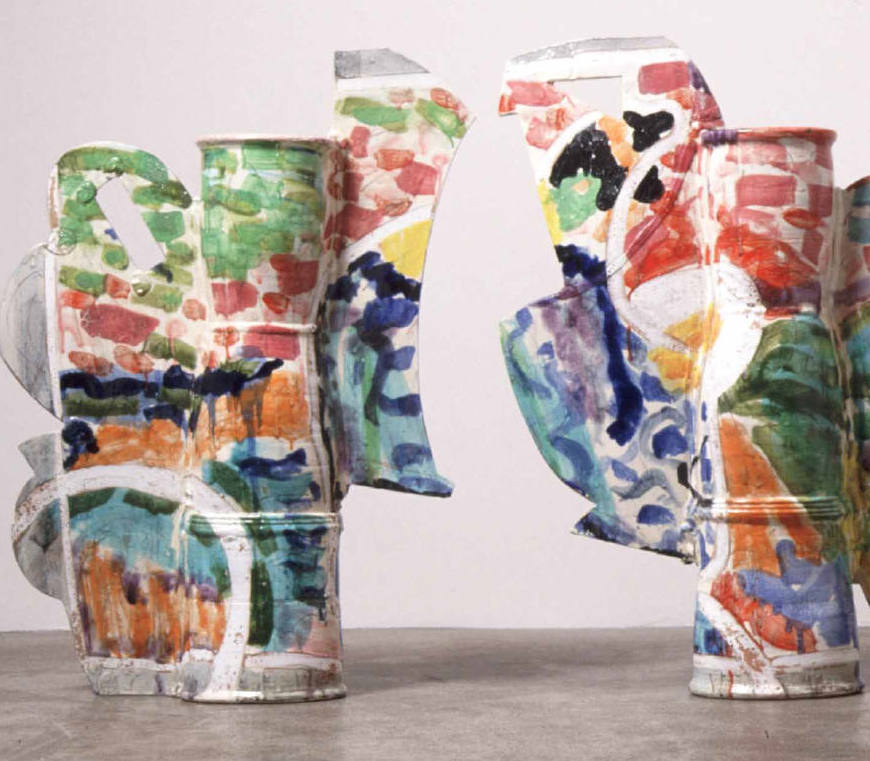
Betty Woodman, June in Italy, detail, 2001
glazed earthenware, epoxy resin, lacquer and paint
Apropos of nothing, a small sample of work from our greatest living colorist, Betty Woodman, who does ceramics which, for me, are really three-dimensional paintings that put Stella’s constructions to shame. The tragic brilliance of her daughter’s photography may have eclipsed Woodman’s Matisse-class talent with color, but her work is a humbling joy, every time I return to it.
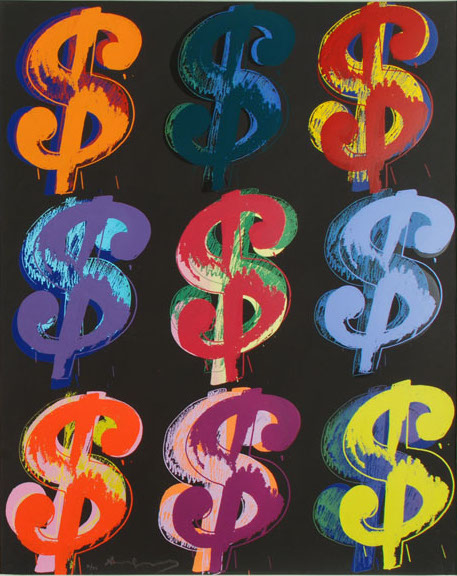
Why it becomes harder and harder to make an ordinary living from painting. (As if it was ever a sensible career path for the merely talented.) Robert Frank in today’s NYTimes: “(Income) inequality in the United States has been increasing sharply for more than four decades and shows no signs of retreat. In varying degrees, it’s been the same pattern in other countries. The economy has been changing, and new forces are causing inequality to feed on itself.
One is that the higher incomes of top earners have been shifting consumer demand in favor of goods whose value stems from the talents of other top earners. Because the wealthy have just about every possession anyone might need, they tend to spend their extra income in pursuit of something special. And, often, what makes goods special today is that they’re produced by people or organizations whose talents can’t be duplicated easily. Wealthy people don’t choose just any architects, artists, lawyers, plastic surgeons, heart specialists or cosmetic dentists. They seek out the best, and the most expensive, practitioners in each category. The information revolution has greatly increased their ability to find those practitioners and transact with them. So as the rich get richer, the talented people they patronize get richer, too. Their spending, in turn, increases the incomes of other elite practitioners, and so on.”
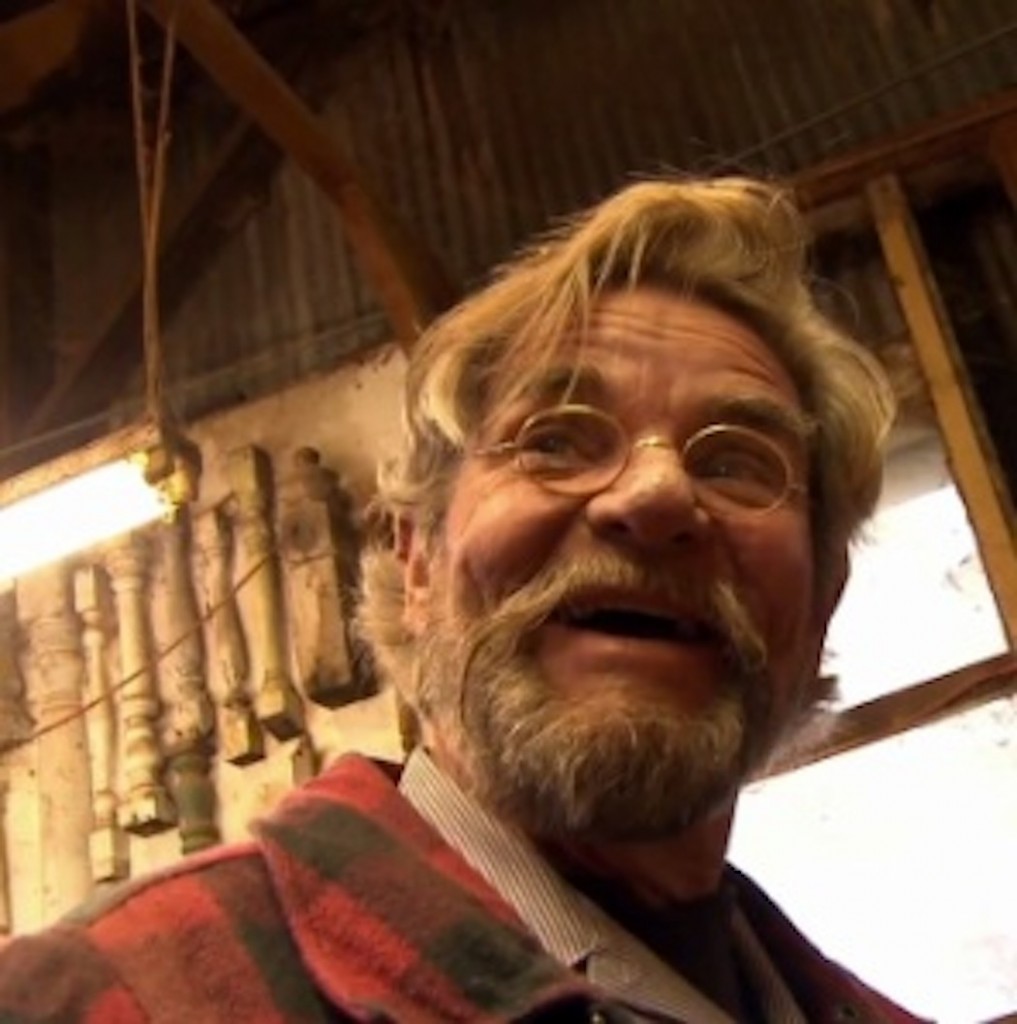
Eric Hollenbeck, craftsman
This short video about a woodworker captures one of the most central reasons I paint: to make something carefully and skillfully by hand.
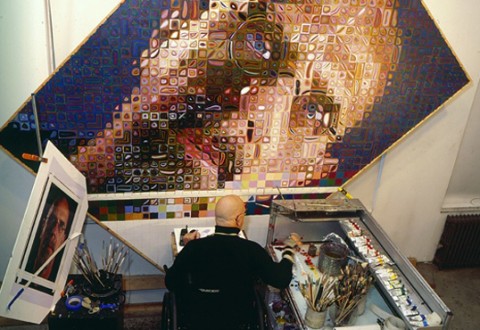
Close at work
“Persistence: we call it getting to know the Muse.”