Archive Page 54
July 14th, 2011 by dave dorsey
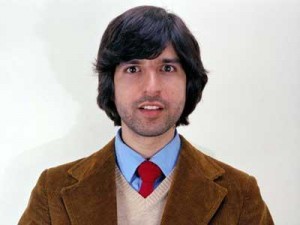
Demetri Martin, comedian and painter
A while back, maybe a couple years ago, Roberta Smith, of the New York Times, observed that visual art is becoming–or has long been–an intellectual ghetto, of sorts, comparable in its reach to the tiny span of influence enjoyed by contemporary poets and their readers. It doesn’t seem that way because so many past artists remain recognizable household names–and their work is still summoned onto the walls of major museums in blockbuster retrospectives. The recent MoMA show, Matisse: Radical Invention, was challenging and illuminating, and offered new insights into how Matisse and Picasso kept a wary, respectful eye on one another, learning, reacting, developing their work in a spirit of competitive homage. It brought to mind how The Beatles and Beach Boys played a bit of one-upmanship when they were recording. Yet a big show like this one also operates on a meta-level, reassuring painters like me that art remains something vital to large numbers of people–with a roster of big names any educated individual will recognize. There’s an illusion built into this subliminal message. The reality is that most great work being done now is completed in obscurity, with little opportunity of reaching large numbers of people, or even any people outside the small community of souls who pay serious attention to visual art. Who do we have now for Big Names? Jeff Koons? Damien Hirst? John Currin? These figures live in a bubble of luxury familiar only to elite CEOs and media celebrities, and yet what percentage of the population would be able to tell you anything about their work, or even recognize their names? Go down a few levels to the little-known people who are doing powerful, beautiful, compelling work, work of genuine quality and value, and you’ll get blank stares from the man or woman on the street–and you’ll find artists who make precious little through the sale of their work. For a painter, the sad reality is that the rewards are entirely inherent in mastering the work itself–and in the hope that, by doing so, you’ll be able to create something that helps someone else connect with what matters in his or her life.
I listen to podcasts while I paint. A lot of them. Marc Maron, Sound Opinions, Radiolab. On a recent Sound of Young America, Jesse Thorn interviewed the cerebral comedian, Demetri Martin. The conversation made some interesting connections between skateboarding and comedy, and then moved on to the subject of visual art–since Martin is a painter. More
July 11th, 2011 by dave dorsey
The Milkmaid
From the autumn of 2009 through the end of last year, I helped Peter Georgescu, a retired CEO, write a book about his extraordinary life. The job required me to fly to Manhattan at regular intervals and stay there for as long as a week at a time.
Here’s the thing. This project, which was rewarding in and of itself, also gave me enough free time to wander around Manhattan to see some impressive exhibitions. There is nowhere like New York City for an education in the visual arts—it’s astonishing what you can learn simply wandering around for a few days. I saw a selection of William Blake’s watercolors at the Morgan Library, including many he did for his version of The Book of Job. The older I get, the more I admire and marvel at Blake’s achievement, though I have almost nothing in common with his visionary aims. I love his work in a personal way partly because J.D. Salinger claimed to love it, which made me curious about the poet in college, and partly because I took a graduate seminar devoted exclusively to his poetry while at the University of Rochester. His Gnostic vision lodged itself in me in a way I’ve never been able to shake. (When I got to London earlier this year, it was a joy to see how the Tate Britain gives props to crazy eccentric Billy Blake, alongside Turner and Constable and all the rest.) On this same visit to New York, I saw a tiny El Greco at the Onassis Cultural Center, The Coronation of the Virgin, which showcased his astonishing facility with oil paint. It was a mere study, and the three faces couldn’t have measured more than an inch from chin to hairline, yet their expressions were incredibly complex and full of emotion—conveying three distinct and recognizable states of mind. We’re talking about faces the size of pocket change. The craftsmanship required to convey this profound depth of feeling through such tiny profiles doesn’t seem humanly possible. I stood in front of that image, silently, for a long, long while. El Greco’s spirituality seemed to find expression as much in the way he handled paint as in any of the religious scenarios he was using it to represent. Seeing that small painting enabled me to understand why the contemporary Chinese installation artist, Chi Guo Chiang is obsessed with El Greco. more
July 11th, 2011 by dave dorsey
There is only one thing in art that is worthwhile. It is that which cannot be explained.
–Braque
July 9th, 2011 by dave dorsey
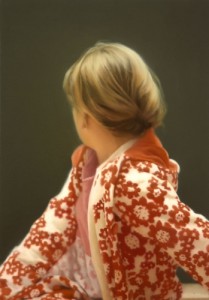
Betty by Gerhard Richter
“One has to believe in what one is doing, one has to commit oneself inwardly, in order to do painting. Once obsessed, one ultimately carries it to the point of believing that one might change human beings through painting. But if one lacks this passionate commitment, there is nothing left to do. Then it is best to leave it alone. For basically painting is idiocy.”
–Gerhard Richter
There is so much to argue against here–this missionary sense of purpose–but Van Gogh would have agreed completely and if Vincent gives something the thumbs up, I’m down with it. The fulcrum here is the phrase “change human beings,” which makes Richter’s credo sound sensible. He doesn’t say “change the world.” It isn’t a social or political agenda he’s talking about–though politics certainly hasn’t been outside Richter’s wheelhouse. Can a painting change you by helping you wake up to who you actually are? As I typed this, a catbird landed on our birdbath here in Pittsford, New York, and I’m thinking, no one has ever made a painting as marvelous as the way this nearly invisible gray bird looks and sounds. Does that bird, by flying into my field of vision and inspiring my humble appreciation for it, just now, change me in some way? If so, I think that’s the way a painting should change someone who looks at it.
July 8th, 2011 by dave dorsey
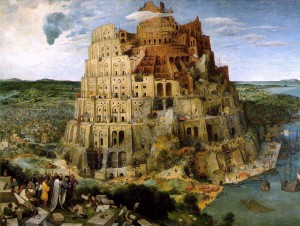
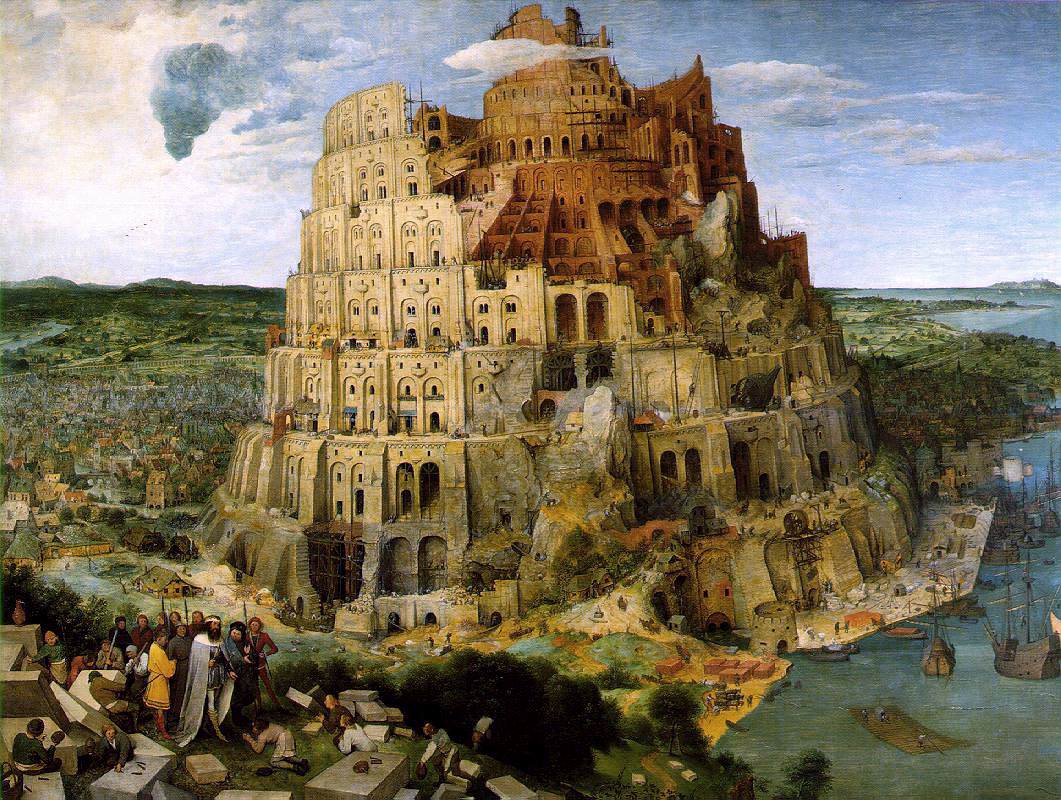
Brueghel's Tower of Babel
Gazing at a great painting for the first time feels a lot like introducing myself to someone fascinating and a little mysterious. Actually, that’s exactly what’s going on. In a sense, I’m becoming friends with the person who created it, and a great painting conceals and reveals itself, as an object of appreciation and understanding, the way its creator would. And what you “learn” from it is analogous to what you learn by becoming friends with someone. It’s more complicated than “knowing.” If the painter has managed to subconsciously fuse his or her life into the work—in other words, insofar as it’s actually a work of art—the painting becomes a portal into who that person is. What it literally represents is beside the point. If the work’s purpose is to illustrate some conscious notion the artist holds—the sordid and oppressive nature of the male gaze, the hegemony of European culture over the Southern hemisphere, the emptiness of celebrity, what have you—it will do what it was meant to do, if it’s good. But it won’t be doing what painting is uniquely qualified to do. Once you get the message, why look twice? More
July 7th, 2011 by dave dorsey

How many words does it require to support an intellectually contrived image? I own The Cremaster Cycle. It’s a cinder block of a book, full of Masonic mystification. In a way, it’s the ultimate Artist’s Statement. I haven’t read a page of it. And I haven’t looked much at the pictures either. My fondest memory of the Matthew Barney show at the Guggenheim (my most unpleasant memory is of buying this enormous book devoted to the show and then straining my lower back by lugging it up along Fifth Avenue) was spotting Isabella Rosselini on one of the upper floors, without makeup, keeping it real by looking really depressed and lost. Some things you can understand only in their context, and that look on her face was one of them. It was the look on my face too.
July 7th, 2011 by dave dorsey
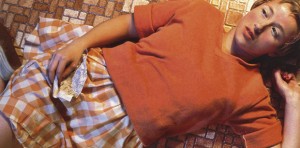
The money shot
Recently, I heard from my friend, Sancho Panza, in Tennessee. (I love Tennessee because it’s hilly and beautiful and because Nick Blosser paints there. But I digress.) Sancho doubts. He mocks. He finds me amusing and occasionally annoying and generally thinks I live in a world of fantasy. Sometimes, he addresses the level of truthiness in my thinking. Other times, he’s dead wrong about whatever, but when it comes to the realm of art it’s refreshing to hear from him. He’s a sort of bollocks alarm. When something looks fraudulent in a groupthinky way, as it often does, in the empire of art, he just comes right out and asks “Who cut the Moose House cheese?” He spotted this item from Popular Photography and proceeded to ask why:
Cindy Sherman’s “Untitled #96″ from 1981 has become the world’s most valuable photograph after selling for a staggering $3.89 million at a Christie’s auction yesterday (it was estimated to be worth up to $2 million). The winning bidder was Philippe Segalot, a private advisor to some of the world’s wealthiest art collectors. The photo takes the top spot away from “99 Cent II Diptychon” by Andreas Gursky, which enjoyed five years as the world’s most valuable photo after selling for $3.35 million back in 2006.
Me: Yes, the auctions are hitting new highs. The bubble continues. She’s an interesting character.
Sancho: How do you explain what the bubble chooses?
Me: She’s been around for decades. She’s “established.”
Sancho: But then they randomly settle on one piece of work? This is what strikes the outsider as nuts. More
July 6th, 2011 by dave dorsey
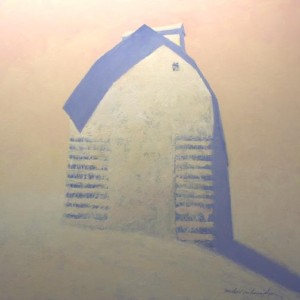
from the Barns collection
If I step back and just observe myself while I paint what I notice is pretty simple—and extremely simple-minded. I become less and less conscious of myself and what I want my activity to mean and far more aware of the feel of what I’m doing. When I know, with the entirely subjective certainty of someone in love, (translate: deaf and blind to the opinions of others) that everything I’m doing is exactly right, a number of conditions hold up. I’m aware of having established a set of personal rules, which I’m following at a steady, rhythmic pace, not too fast, not too slow—the quality of the brushwork, the thickness of the paint, how closely I maintain crisply defined edges and outlines, exactly what colors I will and won’t use, and what kind of sheen I expect the paint to have when I’m finished—slightly matte, not reflective, no shine at all, seemingly as soft as the cloth that supports it.
I might be the only person in the world who cares about these things, ever, but the strange thing about painting well is that these factors become all-important. I’m never focused on what the painting has to say, or what it “means,” or how “significant” it needs to be. All of these variables would appear entirely arbitrary to anyone else, but for me they become an absolute necessity. My Ten Commandments. My Noble Truths. My Rules of Order. Whatever. Once I start swerving away from those personal guidelines, and that steady Dr. Dre tempo they impose on my work, those minute particulars and private measures of excellence, there’s no going back—it’s all More
July 6th, 2011 by dave dorsey
represent
— to present an image of something through the medium of a picture
— to bring clearly before the mind
— to set forth in words; state or explain
— to have the nerve to speak for others of your group