Diarmuid Kelley
January 8th, 2016 by dave dorsey
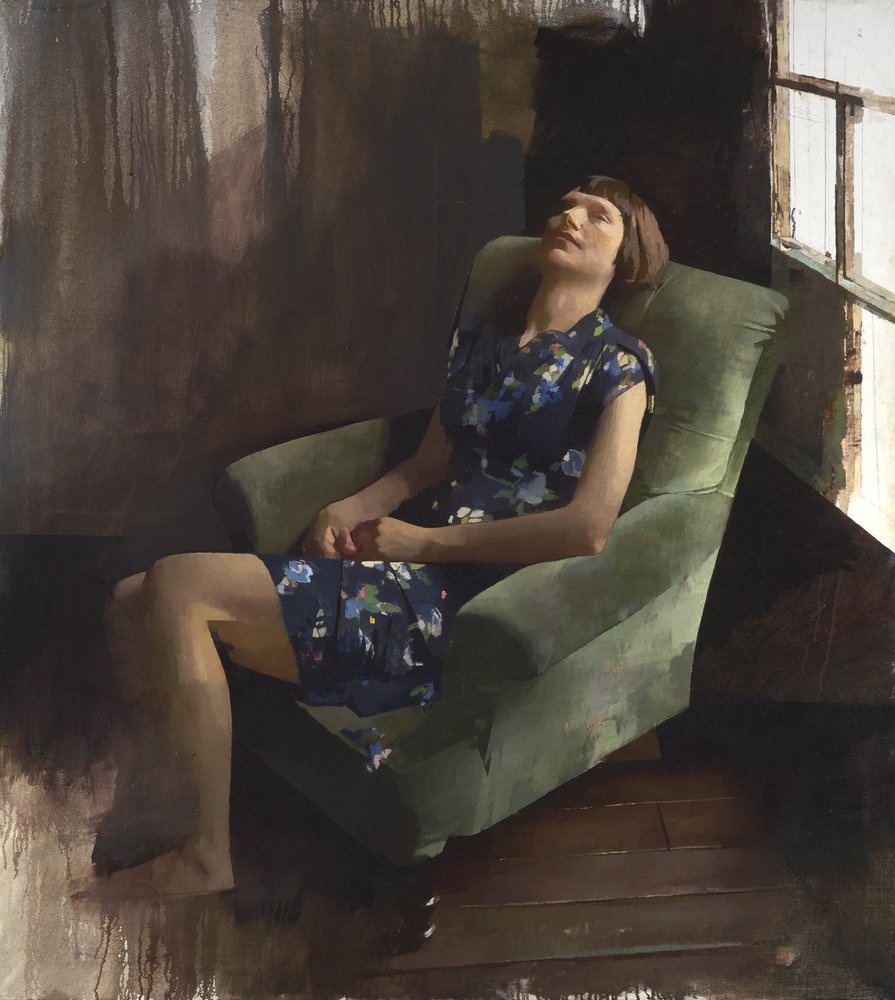
A Guide to the New Elizabethans, Diarmuid Kelley, oil on linen, 60 x 53 1/2
More here.
the painting life
A Guide to the New Elizabethans, Diarmuid Kelley, oil on linen, 60 x 53 1/2
More here.
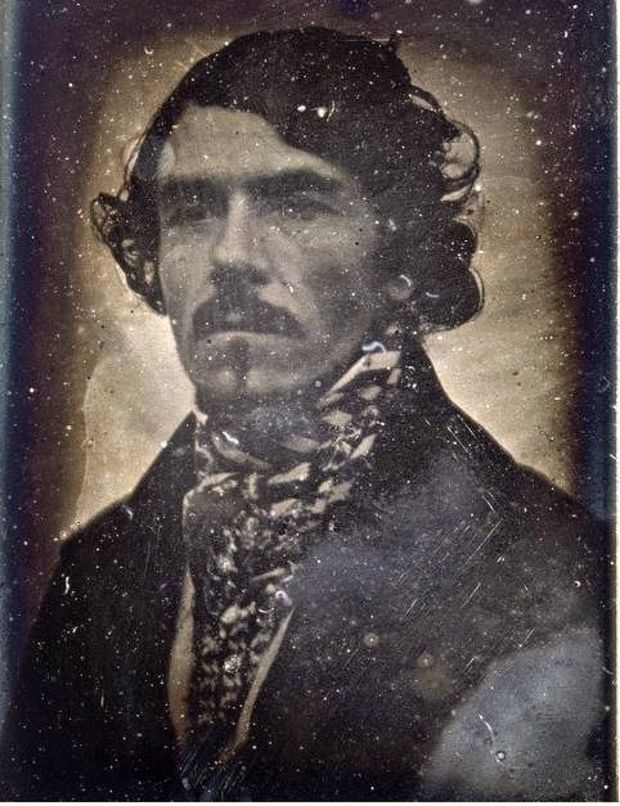
Most writing on art is by people who are not artists: thus all the misconceptions.
—Eugène Delacroix
That’s a quote from a book excerpt in the latest Atlantic about storytelling, which has some references to painting, and a nice quote from Robert Hughes. My life right now has been and will continue to be a long obstacle course that keeps me from painting, and I expect not to be able to get back to it for another couple months. After a year of multiple demands on my time–some of them voluntary, like my ride through New England, but most unavoidable–I’m facing two months with a total focus on some bread-winning writing, which is interesting and challenging, but may be my last chance to keep making a living at it. If it doesn’t succeed, I’ll have far more time to paint, but it will mean less income at an age when I don’t have many options left. Right now, all I want to do is get back to painting. All in due time. My down time is forcing me to imagine where I want to go, when I get back to the easel, and that’s what I’m doing, with some good results. It’s frustrating to have to keep waiting to act on it, though. But at least I’ll be ready and focused when I can.
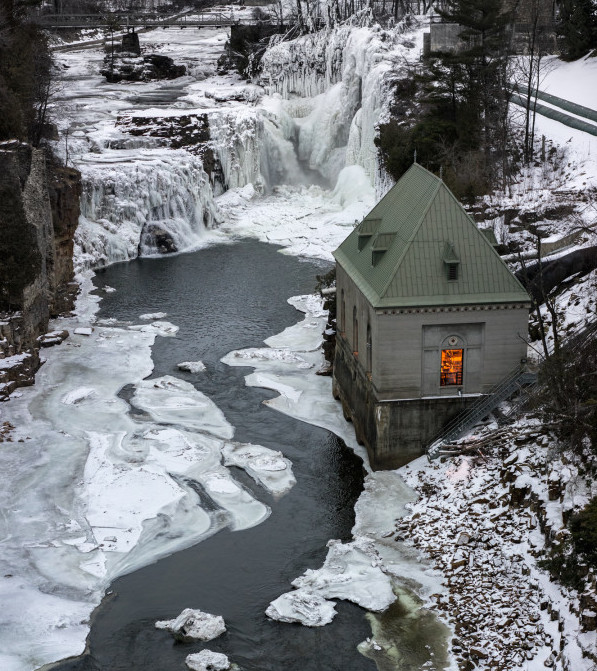
Ausable Chasm, detail, Rick Schatzberg
Ausable Chasm by Rick Schatzberg, of Brooklyn, is currently on view in New York, at Manifest, a regional showcase of work from my home state. This photograph arrived on the front of an exhibition postcard Manifest sent me, and I immediately went to the Web to see the rest of Schatzberg’s work. Much of it has the same quality, where the formal structure mirrors what’s actually being seen: how nature dwarfs the people who find a place in it, the way human figures seem nearly overpowered in classic Chinese scroll paintings. In this one, a tiny rectangle of orange interior light glows invitingly, like a candle, in the middle of a white and gray-green ice world, which is gorgeously indifferent to any upstate hominids trying to stay warm within it. I can fully identify with whoever is inside that structure, though not so much this year, since we finally seem to be seeing the upside of global warming in these parts (or maybe it’s just the long arm of El Nino.) In another of my favorites, Schatzberg captures a scene that’s almost entirely a lush green, with tiny shreds of color to one side, pink, orange and butterscotch, the only indication of human habitation, some laundry and little sliver of roof, along with power wires and a road sign.

Story, Richard Maury, oil on canvas mounted on panel, 21″ x 27 1/2″
Photography of a certain sort—with a shallow depth of field—mimics the way the human eye sees more accurately than an image where everything is equally defined and sharp. What I see when I steady my gaze is actually a very tiny fragment of what’s before me. Right now it’s little more than three words on a computer screen around which everything else hovers, softly indistinct. What’s in sharp focus occupies about a square foot, right at the center, of what’s in view. At TV-distance, maybe three square feet of my entire field of vision are crisply defined. Which, conveniently, is roughly the size of the TV screen. The rest of what’s out there, around the periphery of that target area, remains indistinct. I forget this is the case because my eye is about as mobile and busy as a fly trapped in a room. Unless I’m watching something on that TV, or on my computer, my eye never rests. The sense that I see an entire room in great detail, with clarity, represents a mix of working memory and imagination, my mind constantly assembling and unifying the view. What I see is at any point during the day is, ipso facto, a work of imagination.
This was my thinking recently when I resolved to finish eight or nine small, quick still lifes (photo-realistic in the sense that they will be sourced from photographs with a shallow depth of field where much of what’s shown is out of focus). At about the same time as I decided to try this, Tom Insalaco happened to show me a catalog of Richard Maury’s exhibit at Forum Gallery in 2001. Which, of course, immediately pulled me in exactly the opposite direction: to continue painting images where everything is crisply rendered, as I’ve mostly done. I was fascinated by the still life Tom singled out, showing a few common objects illuminated by natural light presumably through one of his Italian home’s old casement windows. So, when I got home, I found what I suspected was the same catalog from a third-party seller on Amazon, and I ordered it. It arrived a couple days later, and, having studied it for a while, I’m humbled by Maury’s work.
I assume the catalog represents all of the work he completed from 1996-2001, as Robert Fishko suggests in his introduction. It isn’t surprising that he praises Maury so effusively. It wouldn’t faze me if you told me each of these fifteen paintings required a year to complete, yet Maury apparently dispatched them at the rate of about three per year, which is staggering given the level of exactitude.
On the cover, in his self-portrait, everything revolves around his MORE
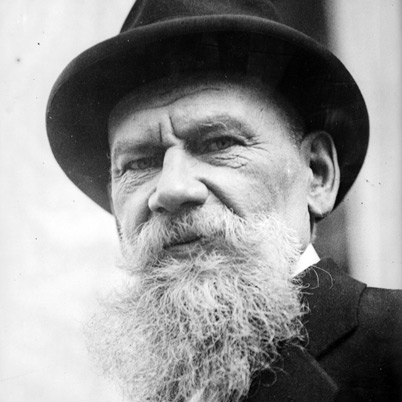
A real work of art can only arise in the soul of an artist occasionally, as the fruit of the life he has lived, just as a child is conceived by its mother. But counterfeit art is produced by artisans and handicraftsmen continually, if only consumers can be found.
That’s a quote from Leo Tolstoy’s What Is Art? Works for me. Like Knausgaard’s attentive account of how he responds to art from different periods, looking at art history from the basis of how it makes him feel—and using that as a basis for assessing whether or not the work actually accomplishes anything—Tolstoy says what strikes me as incredibly obvious and utterly subversive, as Knausgaard is. He expressed (suppressed) truths about all creative activity over the past century or so, in a way that seems undeniable, but problematic. (By art, he means it in the broadest sense, as in “the arts:” poetry, fiction, drama, music, visual art.) If he’s right, then even Shakespeare was bullying us with his Elizabethan vocabulary into a submission to art that reeks of obscurity and privilege, wealth, class divisions, and superiority. My problem is that I love modernism, and I think Shakespeare continues to be the greatest writer who ever lived, and yet Tolstoy was prophetic. Can two contradictory views both be valuable? The book also links art and religion, and religion seems to be popping up constantly in this blog, maybe because I think art and religion are on the same quest, groping in the dark for a moment of illumination about what’s real and true. (Both Wittgenstein, who was essentially a follower of Tolstoy, in his personal life, and Gerhard Richter, refer to their pursuits as “religious.”) “Upper-class art” is, for Tolstoy, simply a generic term for art in his time: the equation of art and “upper-class art” has never been more trenchant than it is now for describing the so much visual art that gets shown, discussed, and bought for the highest sums.
You can read What is Art? for free on the Web. Here are the passages I highlighted years ago in a photocopy of it. They have gotten more and more trenchant as time passes. This is a condensation of passages from page 147 to the end of the book:
For the great majority of working people, our art, besides being inaccessible on account of its costliness, is strange in its very nature, transmitting as it does the feelings of people far removed from those conditions of laborious life, which are natural to the great body of humanity. That which is enjoyment to a man of the rich classes, is incomprehensible, as a pleasure, to a working man, and evokes in him either no feeling at all, or only a feeling quite contrary to that which it evokes in an idle and satiated man.
To thoughtful and sincere people there can therefore be no doubt that the art of our upper-classes never can be the art of the whole people. But if art is an important matter, a spiritual blessing, essential for all men (“like religion,” as the devotees of art are fond of paying), then it should be accessible to everyone. And if, as in our day, it is not accessible to all men, then one of two things (are true): either art is not the vital matter it is represented to be, or that art which we call art is not the real thing.
The first great result was that art was deprived of the infinite, varied, and profound religious subject-matter proper to it. The second result was that having only a small circle of people in view, it lost its beauty of form and became affected and obscure; and the third and chief result was that it ceased to be either natural or even sincere, and became thoroughly artificial and brain-spun.
The impoverishment of the subject-matter of upper-class art was further increased by the fact that, ceasing to be religious, it ceased also to be popular, and this again diminished the range of feelings which it transmitted. For the range of feelings experienced by the powerful and the rich, who have no experience of labor for the support of life, is far poorer, more limited, and more insignificant than the range of feelings natural to working people.
We think the feelings experienced by people of our day and our class are very important and varied; but in reality almost all the feelings of people of our class amount to but three very insignificant and simple feelings: the feeling of pride, the feeling of sexual desire, and the feeling of weariness of life. These three feelings, with their outgrowths, form almost the only subject-matter of the art of the rich classes.
It has come, finally, to this: that not only is haziness, mysteriousness, obscurity, and exclusiveness (shutting out the masses) elevated to the rank of a merit and condition of poetic art, but even incorrectness, indefiniteness, and lack of eloquence are held in esteem.
The fact that I am accustomed to a certain exclusive art, and can understand it, but am unable to understand another still more exclusive art, does not give me a right to conclude that my art is the real true art, and that the other one, which I do not understand, is an unreal, a bad art. I can only conclude that art, becoming ever more and more exclusive, has become more and more incomprehensible to an ever-increasing number of people, and that, in this progress towards greater and greater incomprehensibility (on one level of which I am standing, with the art familiar to me), it has reached a point where it is understood by a very small number of the elect, and the number of these chosen people is ever becoming smaller and smaller.
The assertion that art may be good art, and at the same time incomprehensible to a great number of people, is extremely unjust, and its consequences are ruinous to art itself; but at the same time it is so common and has so eaten into our conceptions, that it is impossible sufficiently to elucidate all the absurdity of it.
We are quite used to such assertions, and yet to say that a work of art is good, but incomprehensible to the majority of men, is the same as saying of some kind of food that it is very good but that most people can t eat it.
Moreover, it cannot be said that the majority of people lack the taste to esteem the highest works of art. The majority always have understood, and still understand, what we also recognize as being the very best art: the epic of Genesis, the Gospel parables, folk-legends, fairy-tales, and folk-songs are understood by all. How can it be that the majority has suddenly lost its capacity to understand what is high in our art?
Great works of art are great only because they are accessible and comprehensible to every one.
The direction art has taken may be compared to placing on a large circle other circles, smaller and smaller, until a cone is formed, the apex of which is no longer al circle at all. That is what has happened to the art of our times.
This has resulted from the following causes. Universal art arises only when some one of the people, having experienced a strong emotion, feels the necessity of transmitting it to others. The art of the rich classes, on the other hand, arises not from the artist’s inner impulse, but chiefly because people of the upper classes demand amusement and pay well for it. They demand from art the transmission of feelings that please them, and this demand artists try to meet. But it is a very difficult task, for people of the wealthy classes, spending their lives in idleness and luxury, desire to be continually diverted by art; and art, even the lowest, cannot be produced at will, but has to generate spontaneously in the artist’s inner self.
Equally little can imitation, realism, serve, as many people think, as a measure of the quality of art. Imitation cannot be such a measure, for the chief characteristic of art is the infection of others with the feelings the artist has experienced, and infection with a feeling is not only not identical with description of the accessories of what is transmitted, but is usually hindered by superfluous details. The attention of the receiver of the artistic impression is diverted by all these well-observed details, and they hinder the transmission of feeling even when it exists.
In our society three conditions co-operate to cause the production of objects of counterfeit art. They are:
While art was as yet undivided, and only religious art was valued and rewarded while indiscriminate art was left unrewarded, there were no counterfeits of art, or, if any existed, being exposed to the criticism of the whole people, they quickly disappeared. But as soon as that division occurred, and the upper classes acclaimed every kind of art as good if only it afforded them pleasure, and began to reward such art more highly than any other social activity, immediately a large number of people devoted themselves to this activity, and art assumed quite a different character and became a profession. And as soon as this occurred, the chief and most precious quality of art its sincerity was at once greatly weakened and eventually quite destroyed.
Infection is only obtained when an artist finds those infinitely minute degrees of which a work of art consists, and only to the extent to which he finds them. And it is quite impossible to teach people by external means to find these minute degrees: they can only be found when a man yields to his feeling. No instruction can make a dancer catch just the tact of the music, or a singer or a fiddler take exactly the infinitely minute centre of his note, or a sketcher draw of all possible lines the only right one, or a poet find the only meet arrangement of the only suitable words. All this is found only by feeling. And therefore schools may teach what is necessary in order to produce something resembling art, but not art itself. The teaching of the schools stops there where the wee bit begins consequently where art begins. Accustoming people to something resembling art, disaccustoms them to the comprehension of real art. And that is how it comes about that none are more dull to art than those who have passed through the professional schools and been most successful in them. Professional schools produce an hypocrisy of art precisely akin to that hypocrisy of religion which is produced by theological colleges for training priests, pastors, and religious teachers generally. As it is impossible in a school to train a man so as to make a religious teacher of him, so it is impossible to teach a man how to become an artist.
These three conditions the professionalization of artists, art criticism, and art schools have had this effect: that most people in our times are quite unable even to under stand what art is, and accept as art the grossest counterfeits of it.
I have little hope that what I adduce as to the perversion of art and taste in our society will be accepted or even seriously considered. Nevertheless, I must state fully the inevitable conclusion to which my investigation into the question of art has brought me. This investigation has brought me to the conviction that almost all that our society considers to be art, good art, and the whole of art, far from being real and good art, and the whole of art, is not even art at all, but only a counterfeit of it.
The difficulty of recognizing real works of art is further increased by the fact that the external quality of the work in false productions is not only no worse, but often better, than in real ones; the counterfeit is often more effective than the real, and its subject more interesting.
The animal unerringly finds what he needs. So also the man, if only his natural qualities have not been perverted, will, without fail, select from among thousands of objects the real work of art he requires that infecting him with the feeling experienced by the artist.
All these people, with very few exceptions, artists, and public, and critics, have never (except in childhood and earliest youth, before hearing any discussions on art), experienced that simple feeling familiar to the plainest man and even to a child, that sense of infection with another’s feeling, compelling us to joy in another’s gladness, to sorrow at another’s grief, and to mingle souls with another, which is the very essence of art. And therefore these people not only cannot distinguish true works of art from counterfeits, but continually mistake for real art the worst and most artificial, while they do not even perceive works of real art, because the counterfeits are always more ornate, while true art is modest.
There is one indubitable indication distinguishing real art from its counterfeit, namely, the infectiousness of art. If a man, without exercising effort and without altering his standpoint, on reading, hearing, or seeing another man s work, experiences a mental condition which unites him with that man and with other people who also partake of that work of art, then the object evoking that condition is a work of art. And however poetical, realistic, or interesting a work may be, it is not a work of art if it does not evoke that feeling (quite distinct from all other feelings) of joy, and of spiritual union with another (the author) and with others (those who are also infected by it).
If a man is infected by the author’s condition of soul, if he feels this emotion and this union with others, then the object which has effected this is art; but if there be no such infection, if there be not this union with the author and with others who are moved by the same work then it is not art. And not only is infection a sure sign of art, but the degree of infectiousness is also the sole measure of excellence in art.
I have mentioned three conditions of contagiousness in art, but they may all be summed up into one, the last, sincerity, i.e. that the artist should be impelled by an inner need to express his feeling.
It is always complied with in peasant art, and this explains why such art always acts so powerfully; but it is a condition almost entirely absent from our upper-class art, which is continually produced by artists actuated by personal aims of covetousness or vanity. Such are the three conditions which divide art from its counterfeits, and which also decide the quality of every work of art apart from its subject-matter. If the work does not transmit the artist peculiarity of feeling, and is therefore not individual, if it is unintelligibly expressed, or if it has not proceeded from the author’s inner need for expression it is not a work of art. If all these conditions are present, even in the smallest degree, then the work, even if a weak one, is yet a work of art.
A real work of art can only arise in the soul of an artist occasionally, as the fruit of the life he has lived, just as a child is conceived by its mother. But counterfeit art is produced by artisans and handicraftsmen continually, if only consumers can be found.
Art will become accessible to the whole people, because, in the first place, in the art of the future, not only will that complex technique, which deforms the productions of the art of to-day and requires so great an effort and expenditure of time, not be demanded, but, on the contrary, the demand will be for clearness, simplicity, and brevity . . .
And therefore security of maintenance is a condition most harmful to an artist s true productiveness, since it removes him from the condition natural to all men, that of struggle with nature for the maintenance of both his own life and that of others, and thus deprives him of opportunity and possibility to experience the most important and natural feelings of man. There is no position more injurious to an artist’s productiveness than that position of complete security and luxury in which artists usually live in our society. The artist of the future will live the common life of man, earning his subsistence by some kind of labor. The fruits of that highest spiritual strength which passes through him he will try to share with the greatest possible number of people, for in such transmission to others of the feelings that have arisen in him he will find his happiness and his reward. The artist of the future will be unable to understand how an artist, whose chief delight is in the wide diffusion of his works, could give them only in exchange for a certain payment.
And indeed, for the artists of our society and day, it is impossible, but not for the future artist, who will be free from all the perversion of technical improvements hiding the absence of subject-matter, and who, not being a professional artist and receiving no payment for his activity, will only produce art when he feels impelled to do so by an irresistible inner impulse. The art of the future will thus be completely distinct, both in subject-matter and in form, from what is now called art. The only subject-matter of the art of the future will be either feelings drawing men towards union, or such as already unite them; and the forms of art will be such as will be open to everyone. And therefore, the ideal of excellence in the future will not be the exclusiveness of feeling, accessible only to some, but, on the contrary, its universality. And not bulkiness, obscurity, and complexity of form, as is now esteemed, but, on the contrary, brevity, clearness, and simplicity of expression.
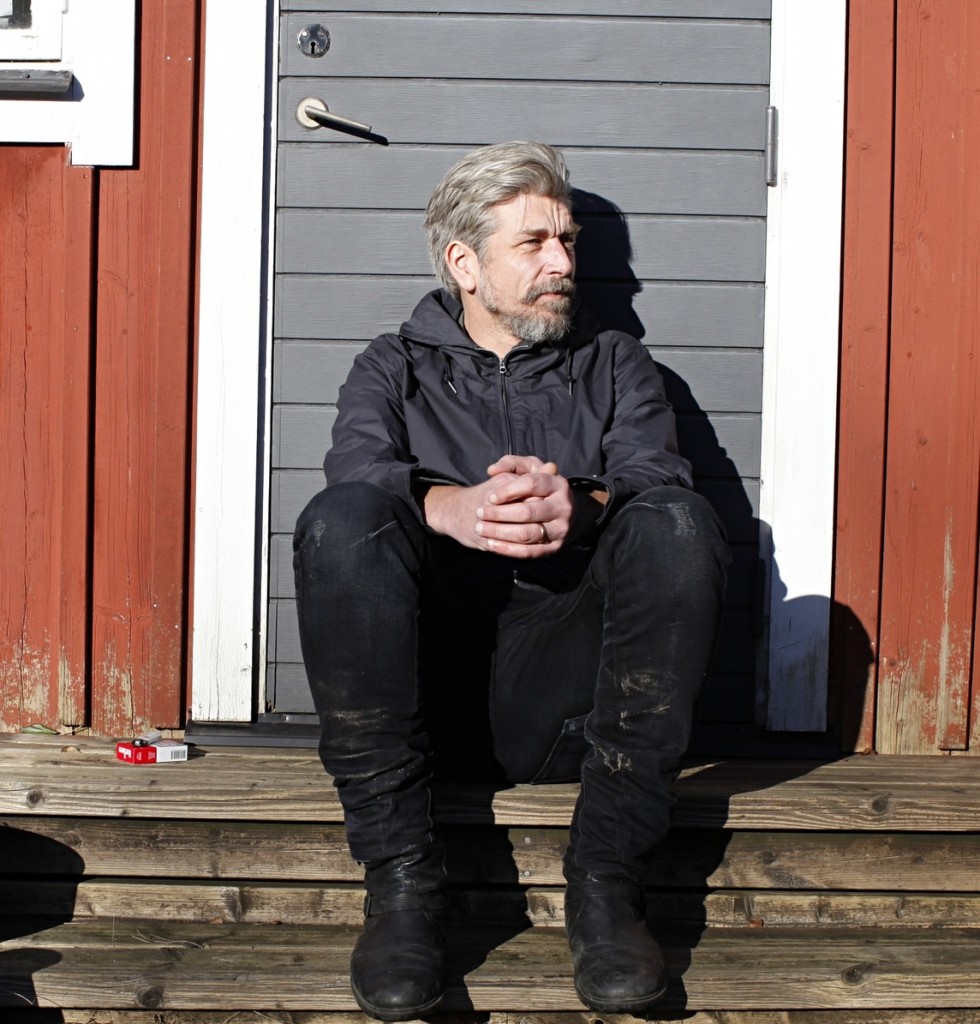
Karl Ove Knausgaard
After about two hundred pages, My Struggle, Book 1, by Karl Ove Knausgaard, abruptly shifts into a higher gear as a brief account of his falling in love as a teen with a girl named Hanna serves as a threshold for him to leap into the future, much closer to the present, and describe his life as a writer and expectant father in Stockholm. His indebtedness to Proust becomes even more evident than it already has been in the way he drifts from narrative to essay–the book begins with a startling, riveting account of what we do with the bodies of the dead, how we hide them immediately and inexplicably keep them close to the ground. It’s a phenomenological examination of our collective denial of mortality–the oddity of our rituals around it as an avoidance of the unknowable. Here, two hundred pages later, he launches into a meditation on visual art which, at the end, comes full circle, halfway through the book, finally, with those opening Montaigne-like observations about mortality. He isn’t just talking about death here, but about consciousness itself. “The intellect has taken over everything.” He points to the unreality of the world we inhabit now, and is trying to show how we’ve increasingly transformed our world into a virtual, intellectual shadow-play where ideas and concepts replace the actual phenomena of experience, and within all of this is embedded a critique of art since Manet. What he says here reflects my reactions in London when I walked through the Tate, which I loved, compared to the Tate Modern, which left me not only cold, but feeling a surprising aversion for a lot of what I saw there, even though I love so much art from the past century. Something about the place itself seemed almost inhuman and repellent. It was like the divide between reason and feeling Knausgaard outlines in his reaction to visual art: feeling increasingly has no place in creative work devoted to concepts, irony, theory, and analysis. His extreme reaction to certain paintings is almost comical, but he isn’t trying to be funny; for him it’s like finding water in a desert:
“. . . . a book about Constable I had just bought. Mostly oil sketches, studies of clouds, countryside, sea. I didn’t need to do any more than let my eyes skim over them before I was moved to tears. So great was MORE
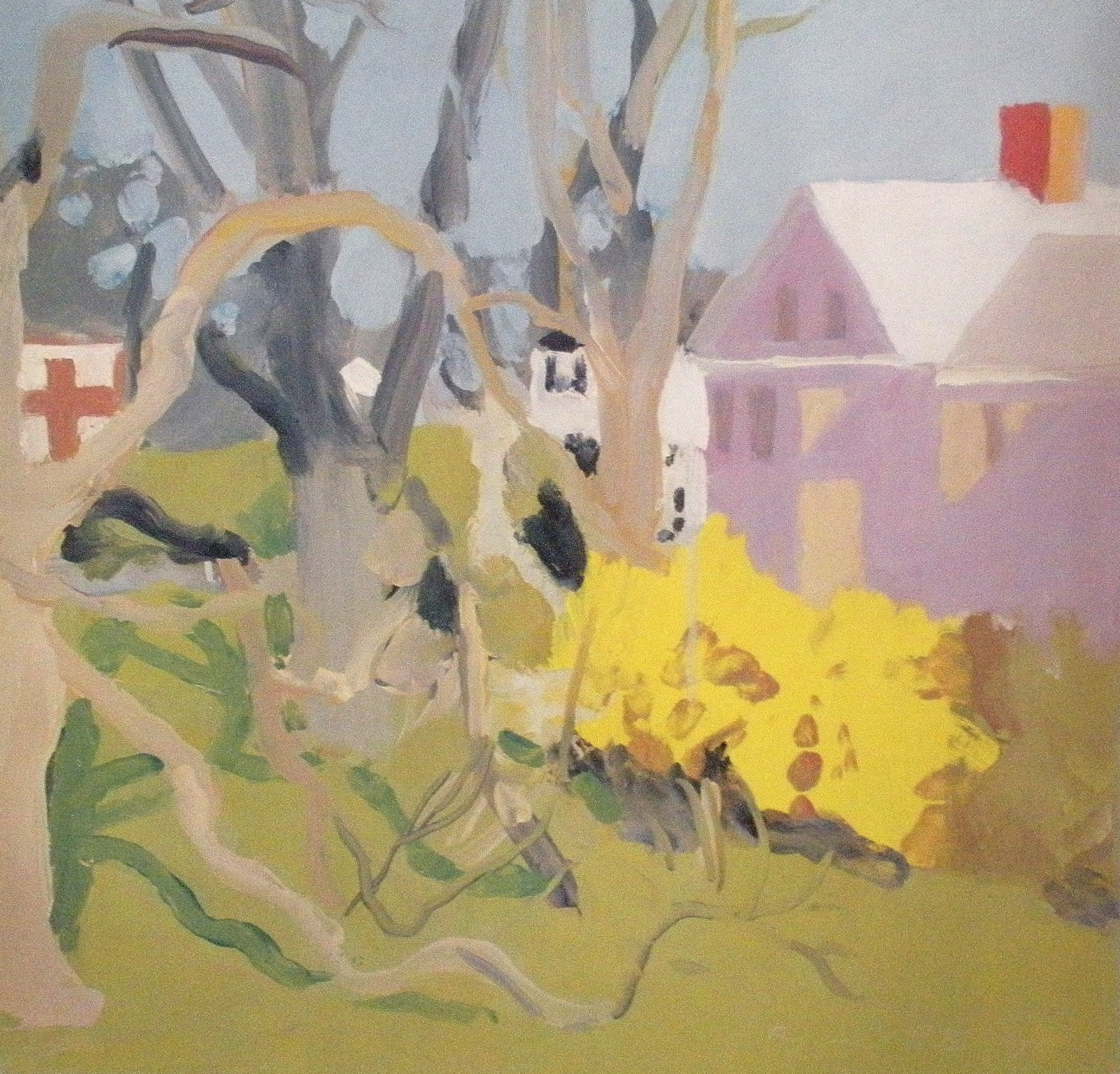
Spring Landscape, Fairfield Porter
“On the school playground that lay squashed between two blocks of flats twenty meters up from my office the shouts of children suddenly fell quiet, it was only now that I noticed. The bell had rung. The sounds here were new and unfamiliar to me, the same was true of the rhythm in which they surfaced, but I would soon get used to them, to such an extent that they would fade into the background again. You know too little, and it doesn’t exist. You know too much, and it doesn’t exist. Writing is drawing the essence of what we know out of the shadows. That is what writing is about. Not what happens there, not what actions are played out there, but the there itself. There, that is writing’s location and aim. But how to get there?”
–Karl Ove Knausgaard, My Struggle, Book 1
Though I take exception to that word “know,” this is a brilliant little passage, in the way his perspective snaps outward to encompass everything. Knausgaard begins with what we’ve all experienced: you are either too far from the sound of children playing to hear them or you are so close, in a sustained way, hour after hour and day after day, that you cease to hear them because they have become mere white noise. They have become the backdrop you forget as you watch and listen to what’s going on in the little spotlight of attention your mind sheds on whatever place you’re in. Knausgaard moves immediately, with a little metaphoric step, to a slightly different point about conscious awareness in general: the “there” of the world is so unceasing that we become oblivious to everything in our environment, and in ourselves, other than the little novelties of our daily experience. Too little or too much of the children laughing, and you cease to hear them. The world as a whole is far too much with us. It just is, and you are the world you’re in–you can’t step away from it and get a comprehensive look at it, as you could some space you occupy. You are it. You would have to be able to step out of yourself. Constantly, the “there” of your world disappears, and remains out of reach, unrecognized, if not for art, or meditation, or the taste of a madeleine dipped in tea, or a song that became your daily world twenty or thirty years ago and was forgotten until you heard it again just now. And suddenly you behold the “there” of that world, from back then, for the first time.
In a dozen posts, so far, and in dozens more, no doubt, this is something I’ve been getting at, though in the context of painting, rather than MORE
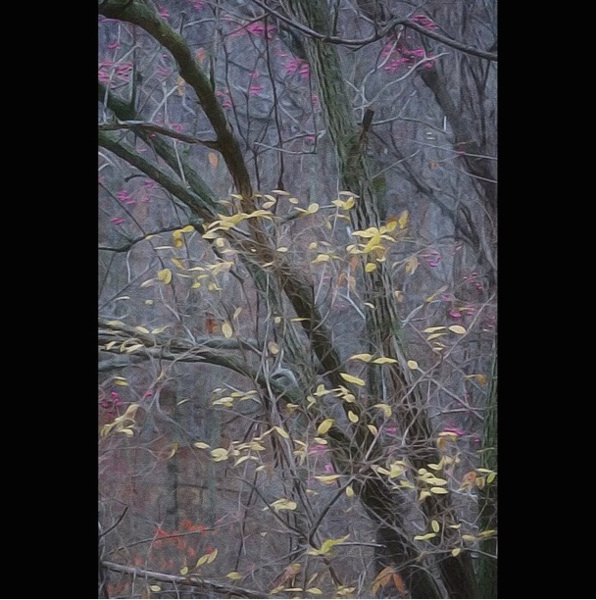
@guywithtie on Instagram
This gushing account of how Instagram is disrupting the supply chain of fine art cracked me up, it sounded so over-the-top. In due time, I’m going to devote my Instagram mostly to my painting, and I’ll report on whether or not His Serene Highness Pierre d’Arenberg will allow my paintings to dry before he sends me his credit card number for the overnight shipping. I guess I’m expecting something a little less hectic than the feeding frenzy offered here by Vogue:
The social media platform is not only launching the career of under-the-radar artists, it is providing the world with an entirely new way to access art. Where artists once had to first get support of the art world elite—critics, galleries and big name collectors, which would eventually lead to museum shows—before reaching the monied masses, today artists use Instagram as their own virtual art gallery, playing both dealer and curator while their fans become critics and collectors, witnessing the creative process in real time.
“I can post a painting and it will sell before the paint is dry,” explained artist Ashley Longshore,whose glossy crystal-covered canvases are regularly bought straight off her Instagram feed for upwards of $30,000. The 37-year-old is based in New Orleans but will often ship her artworks directly from her Uptown studio to London, Tokyo, and Switzerland, where she recently sold a painting to His Serene Highness Pierre d’Arenberg for an undisclosed amount. “My collectors will text and email me their credit card details, they mail checks; it is literally a frenzy to see who can whip out their AmEx first!” admits Longshore, whose nearly 2,000 Instagram followers, and subsequent clients, include the likes of Blake Lively, the former President of Time Inc. Digital, Fran Hauser, and “one of the wives” of the Rolling Stones. “Technology is the platform of my business: All I need is my iPad, my Instagram and a delivery truck to haul all of this gorgeousness to the new homes where they will hang.”
“Like many technology disruptions, it levels the playing field,” says Kenneth Schlenker, the CEO and cofounder of Gertrude.co, a recently launched online platform where New Yorkers can sign up for modern-day art salons that bring collectors and the curious together to learn about, discuss and buy contemporary art in informal settings. “It used to be impossible for an artist to reach a massive audience directly,” he said, adding that “what is happening to art is comparable to what happened to music: The cards have been reshuffled.” Musicians don’t necessarily need record companies to distribute their work anymore—anyone can put an mp3 up on SoundCloud or video on YouTube and reach millions. Similarly, Schlenker says, Instagram gives artists the ability to control the way their story is told, and find people who want to hear it.
You know, these days, it can be hard to get real gorgeousness for only $30,000. No wonder it’s flying off the easel.
The comparison to music is a good one, and the Internet has allowed creators to eliminate middlemen left and right, yet the consumer/connoisseur is desperate to replace them. I don’t go searching for new music by scrolling through sites where unknowns post work: I listen to critics play me a sample of what they like, which is about as old school as it gets, except for the fact that I’m downloading podcasts to hear them: Sound Opinions, All Songs Considered. Maybe Instagram is different, but if all artists get a handle and start posting, how is anyone going to sort it all out, except by accidentally stumbling onto something good?
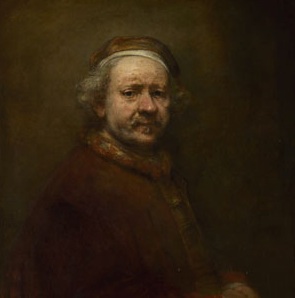
Rembrandt at the age of 63, National Gallery of Art, detail
From The Guardian, on how artist’s peak at different ages:
The Japanese master Hokusai was one day found weeping at his workbench because he believed he had not yet learned enough about drawing. He was 80. On his deathbed, eight years later, he cried out, “If heaven would only grant me 10 more years, I might still become a great artist.” We may consider Hokusai a genius from childhood but he thought nothing he produced before the age of 70 was any good. How long does it take to become an artist?
At 70, like Hokusai, some artists begin to think they are at last getting somewhere even if the spotlight has eluded them. Louise Bourgeois, still sculpting weeks before her death at 98, said that the lack of interest in her art up to this point at least left her to work beautifully undisturbed.
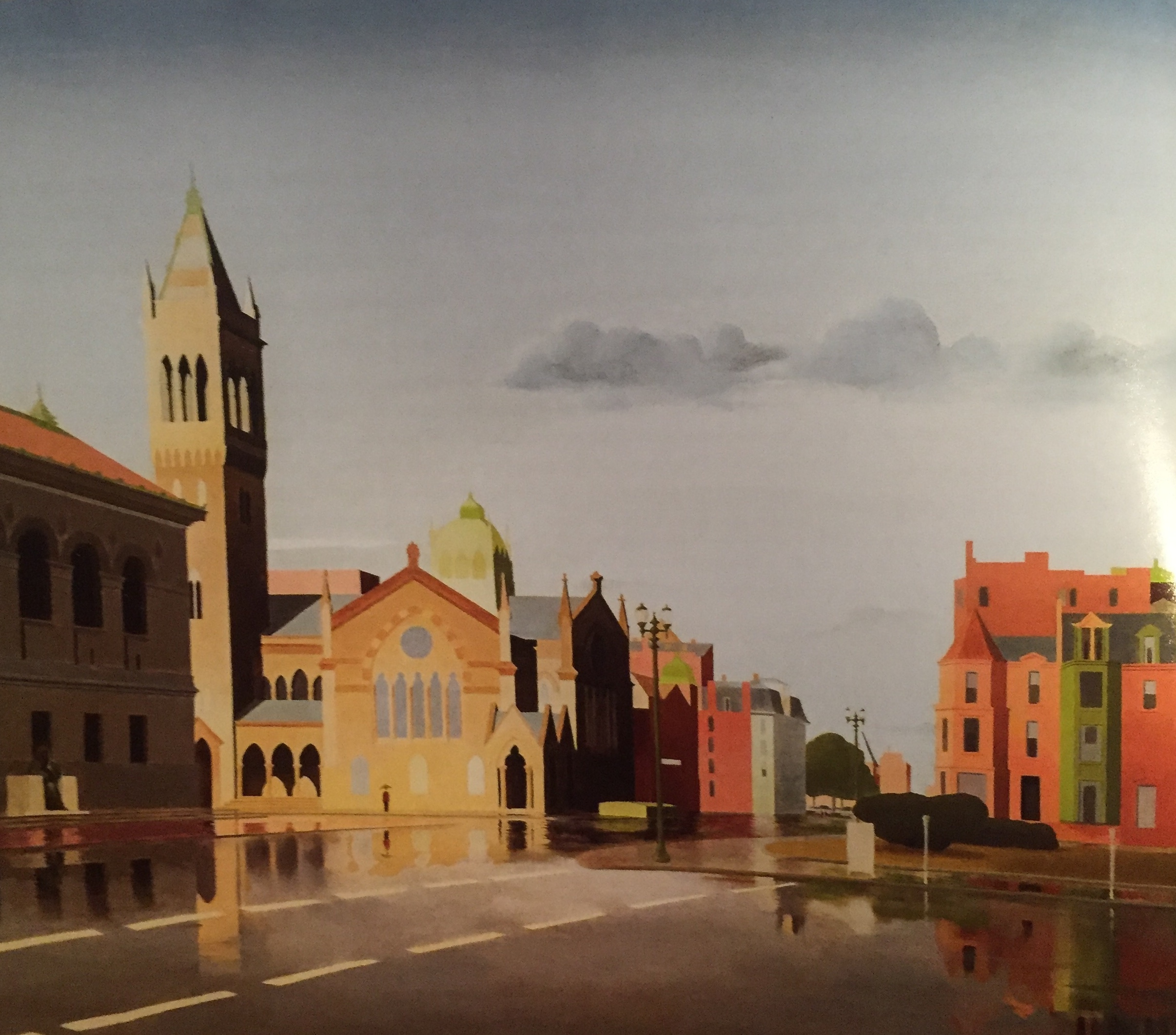
Currently on view at Hirschl & Adler:
Thomas Fransioli (1906-1997)
Copley Square, Boston, 1959-61
Oil on canvas, 24 x 30 in.
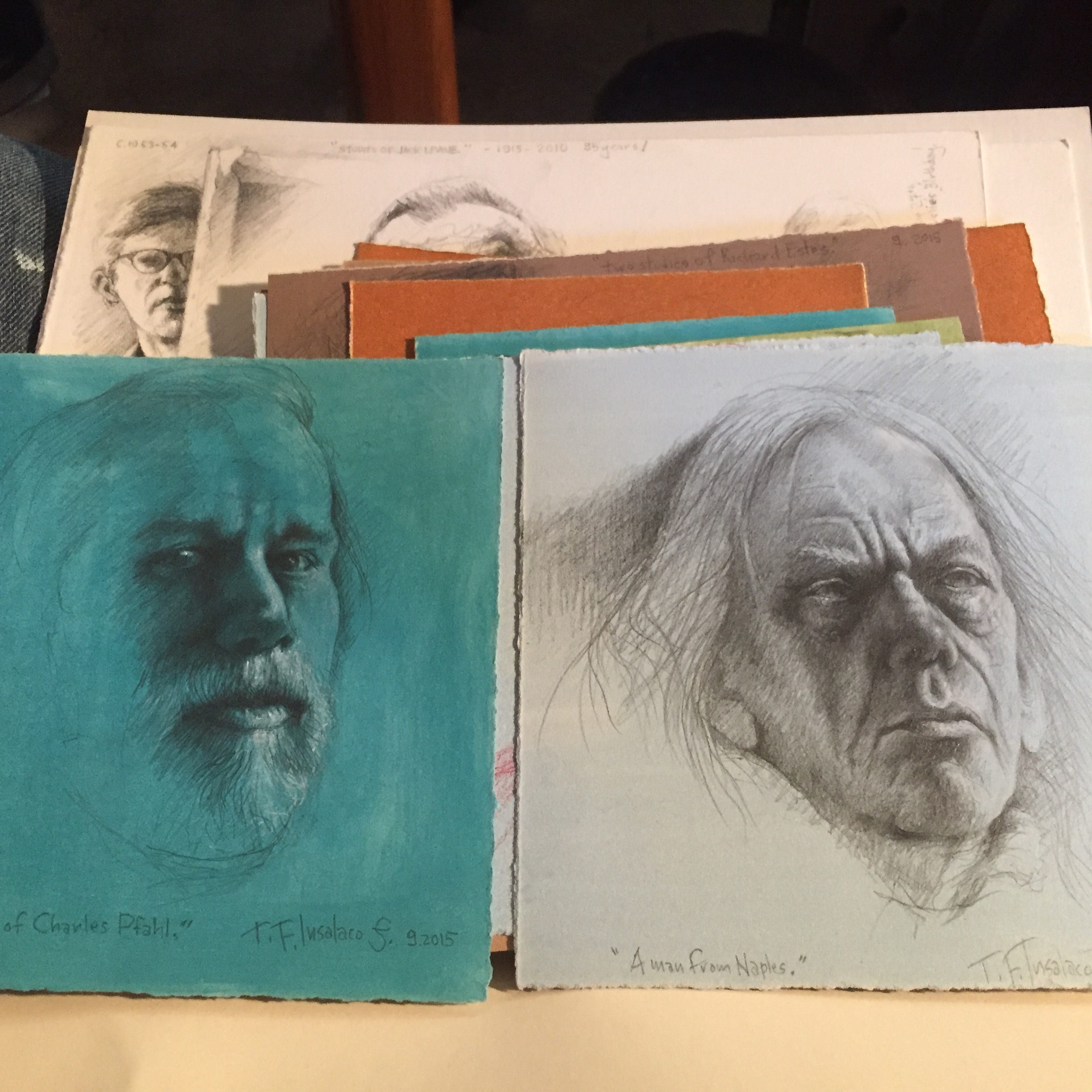
A couple examples of Tom’s warm-up work
During the recent afternoon I spent with Tom Insalaco at his home studio, I saw some of the amazing work he’s done over the past several decades. It’s a measure of his humility and generosity that he spent less time showing me his own work than he invested in introducing me to—or reminding me of—great work from other contemporary realists.
When he could have been pulling big paintings out of storage for me to photograph, instead he handed me a catalog of work by Richard Maury, a slim set of wonderfully printed plates from a show more than a decade ago at Forum. He pulled it out the the midst of hundreds of books Tom keeps on his shelves, including the entire catalog raissone of John Singer Sargent. Tom has spent a lot of time in Italy and ran into Maury there once:
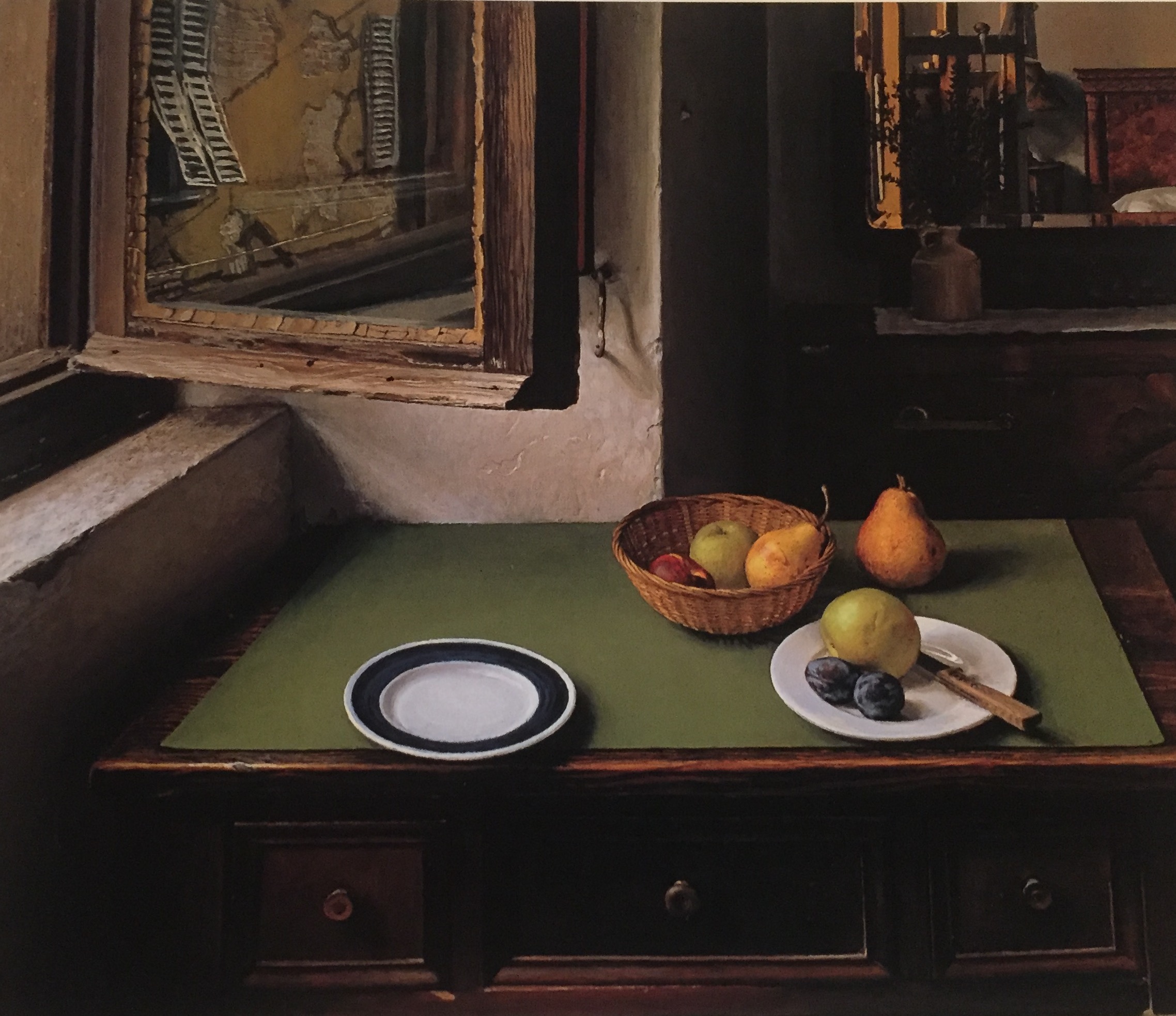
Still Life While Listening to Brahms, Richard Maury
“He’s wonderful. In one of his paintings, you can sense the terra cotta under the glaze on a little ceramic jar. You can sense the depth of the glaze. We found his house in Florence and who comes walking out the door but his wife. I was in Florence and was walking to a church to look at Masaccio, and we stopped a guy with red hair, and he said something and I said something . . . and it was Richard Maury. I didn’t realize it at the time. He was speaking in Italian, but he knew the ins and outs of English. He really had bright red hair back then.”
We talked for several hours, and Tom showed me dozens of drawings from a collection of the ones he has done every morning, without fail, on sheets of rag paper he has prepared by tinting them with oil—“It has to be rag paper.” Working from the overall middle tone he lays down, he creates portraits of people from photographs in the Renaissance manner, adding darker tones the usual way and then highlighting with white. (I recently skimmed through a catalog from the fantastic Durer show of drawings and prints at the National Gallery of Art in 2013 and was surprised by how intensely white Durer’s work was in those highlighted areas.) What was impressive was the size of that sheaf of sketches—Tom draws every morning, first thing, before doing anything else. Up, out of bed, he begins drawing immediately. When he’s done, he gets a little breakfast and then it’s on to his easel at the front of the house.
I’m guessing that Tom is in his mid-70s now, but hasn’t slowed down at all. He has a better memory than I do, and recalls things I’ve told him in passing about my wife and brother and parents, and also comes up with names of specific paintings by artists who don’t even ring a bell with me. He has no patience with contemporary art, and his recent visit to the new Whitney nearly enraged him when he saw the floor of one gallery space covered with a foot of mud—a recent installation.
“I don’t know if you’ve been to the new Whitney. Last time I was in there I screamed. I said why don’t you have the art, instead of this? There was a room full of mud, twelve inches deep. They probably thought they needed to call the police. It was chicken shit. They have so many great paintings. Edward Hopper’s Sunday Morning. Jack Levine’s Feast of Pure Reason. Why don’t they hang that?”
I timidly suggested that the Stella retrospective there now might help ameliorate the effect of the mud, and he allowed that this might be the case, but still . . .
It’s refreshing to talk with someone so candid and unguarded about how he feels when confronted with much of what’s happened to visual art. What I don’t understand, I told him, is why a curator in Western New York isn’t putting together a retrospective of Tom’s work, which reached epic proportions in a trilogy of paintings he did to commemorate the death of his brother a couple decades ago—he was a Buffalo police officer and was murdered by a participant in a domestic fight. One moment his brother was walking up to the door of the house; a few seconds later, he was dead, shot by the man he had come to restrain. Those paintings are monumental; but Insalaco has been building on that work ever since, drawing mostly from Renaissance precursors for his methods, with a bit of Dali tossed in. He was told a year ago or so that he has been invited to exhibit more often in the Memorial Art Gallery’s Finger Lakes Exhibitions than any other artist in Western New York—it’s the most prestigious juried exhibition open to all artists this side of Albany. So why isn’t someone putting together a definitive survey of what Tom has done throughout his career? He wasn’t even included in the most recent Finger Lakes. It would be a wonderful exhibit.

From “Tiny Tokyo: The Big City Made Mini”, Ben Thomas
For a guy, c’est moi, who thinks street photography reigns supreme when it comes to cameras, this photography from Ben Thomas is hard not to love in a completely different way. Tilt-shift images are impossible to resist–you’re a child again, the world your playhouse–yet in his Chroma series, the way he transforms images into flat, hard-edged abstractions, with such a limited range of color, is just as satisfying, even if you want him to free it up a little. They’re like pages coloring books for photo-realists.
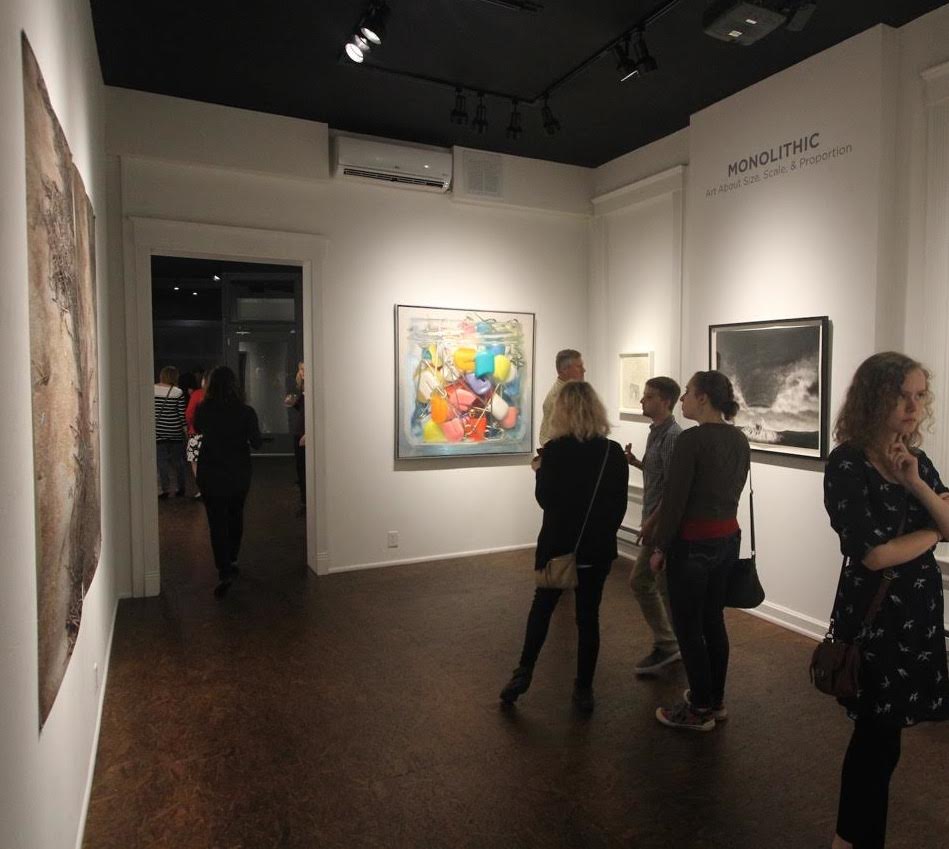

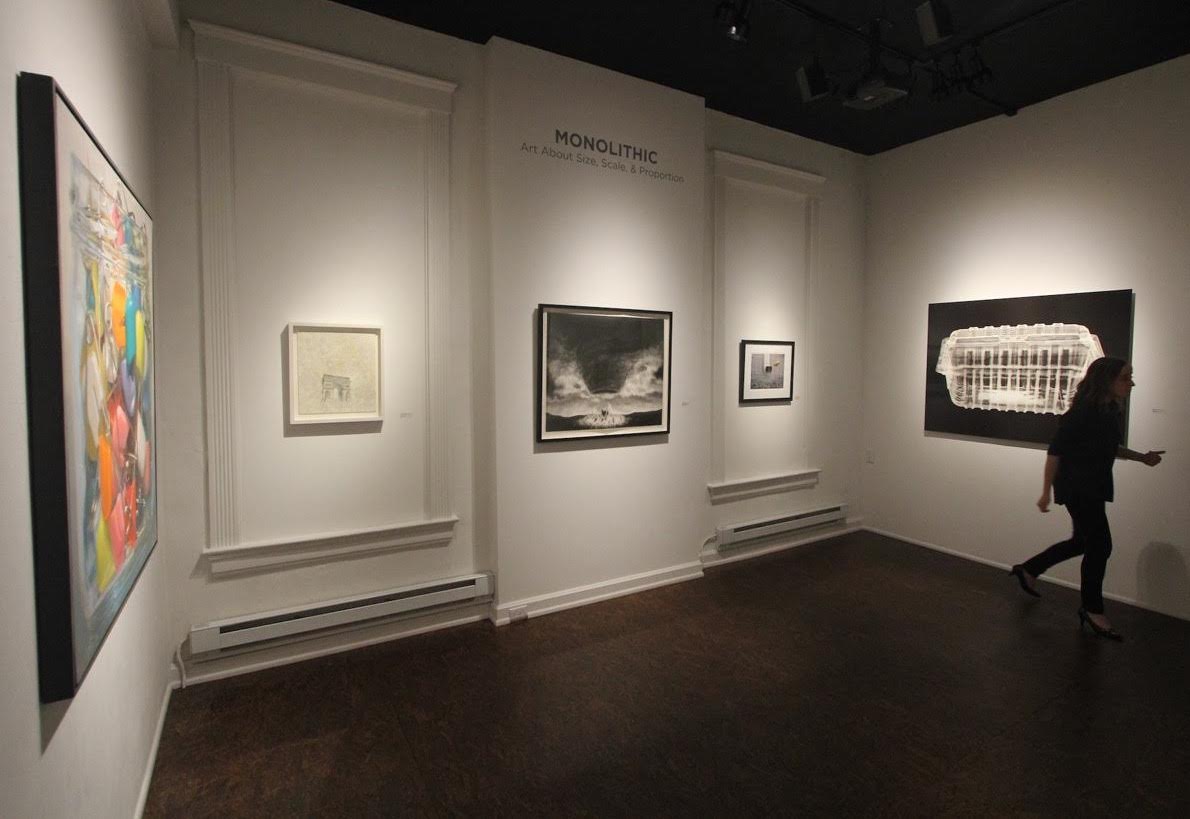
It’s more expensive, and it takes longer, to fly to Cincinnati than to L.A., and the drive requires an entire work day–just one way–so it’s almost more inaccessible than most cities in the country for someone who lives in Rochester. But at least Jason Franz sends shots of the shows to his participants–and in these you can see my jar full of safety pins among some elegant company at Monolithic, one of the exhibits at Manifest right now.
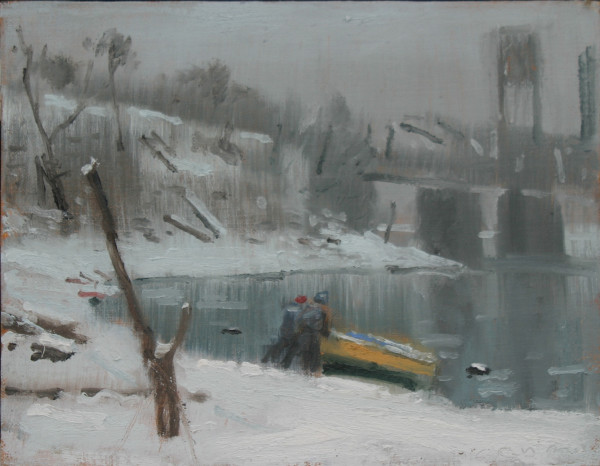
Shore Boat at the Cove, 2014, oil on panel, 10″ x 8″
From Gabriel Liston’s site with the comment: “People live in old boats anchored in the water here between the BNSF bridge and the St Johns.” The modulation of the tones to capture the light is fantastic–it’s the look of a typical winter day here in Rochester, though this one is from Oregon.
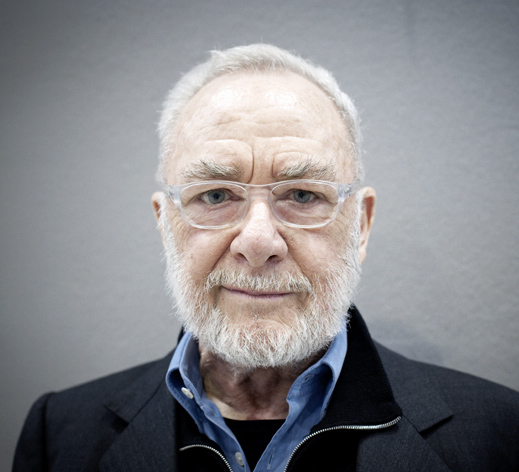
From Forty Years of Painting, the catalog for a great Gerhard Richter retrospective I saw in 2002 at the Museum of Modern Art, some thoughts on when he was an obscure and struggling artist. In the interview, he stresses how his aims, in representational work, are classical. It’s a tremendously honest discussion: “I wanted to be seen.” When a friend of mine saw his work recently he said, “I think he’s the greatest painter alive.” Mission accomplished, Gerhard. My interest in Richter is that his work found a place in art history mostly by simply being incredibly good, but also by finding his own way to paint, on his own, without concerning himself with the notion of “progress” or “movements” in art. His sense of alienation from the art of the 60s and 70s makes him a forerunner for everyone now who has to see art as a uniquely individual pursuit, redefining what’s “new” in a completely individual way. You can’t return to the past, but to employ techniques and methods from the past doesn’t require you to be ironic about them. I love the term “tin art” Richter uses. And yet apparently he was pals with Blinky Palermo and “Bob” Ryman, who would seem to be in the minimalist club, so his work is a natural affirmation of what he most values rather than a reaction against other work. He’s candid about his vulnerability in the 60s: “He was a real artist. Not like me.” The interviewer tries to pin down whether Richter is being ironic in his embrace of tradition, whether Richter is really just doing a postmodernist dance, undermining culture, and so on, but Richter answers like a politician about the “absence of the father.” Say what? It’s amusing; yes, the loss of authority, the loss of “the father,” I get it, but he’s still wriggling away from the question.The century as a whole was problematic for him, not to mention the current century, and it’s clear how his feelings are anchored, even though in his abstracts he certainly found a way to embrace modernism. The interviewer manages to fuse modernism and postmodernism into this one sentence as the 20th century club Richter didn’t want to join (his abstracts weren’t under discussion) and Richter agrees he didn’t want to be a part of it:
Your evocation of the classical was basically a response to the whole mood of the late 1960s, early 1970s, where the general rules were: Away with the old; Everything must be new; and Everything must be a cultural critique.
Yes. Exactly.
But that interpretation differs from what many people seem to think the work is about.
Oh really!
Some critics seem to regard the 48 Portraits as an empty, almost stamp-like array of cultural icons. Why do you think it has had strong response?
If it was only postage stamps it wouldn’t be as elaborate, and there wouldn’t be as much trouble. It is too big and there is too much presence and always people wonder what it is about. Women are angry because there are no women. It keeps upsetting people again and again. People are always upset when confronted with something traditional and conservative, and therefore they don’t want it. You’re not allowed to do that; it is not considered to be part of our time. It’s over, reactionary.
Some critics explain it to themselves–make it okay to like–by arguing that it’s an exercise in rhetoric, the rhetoric of a certain kind of representation of culture that questions or nullifies that culture’s authority.
And as I mentioned, you also have the psychological or subjective timeliness of the father problem. This affects all of society. I am not talking about myself because MORE
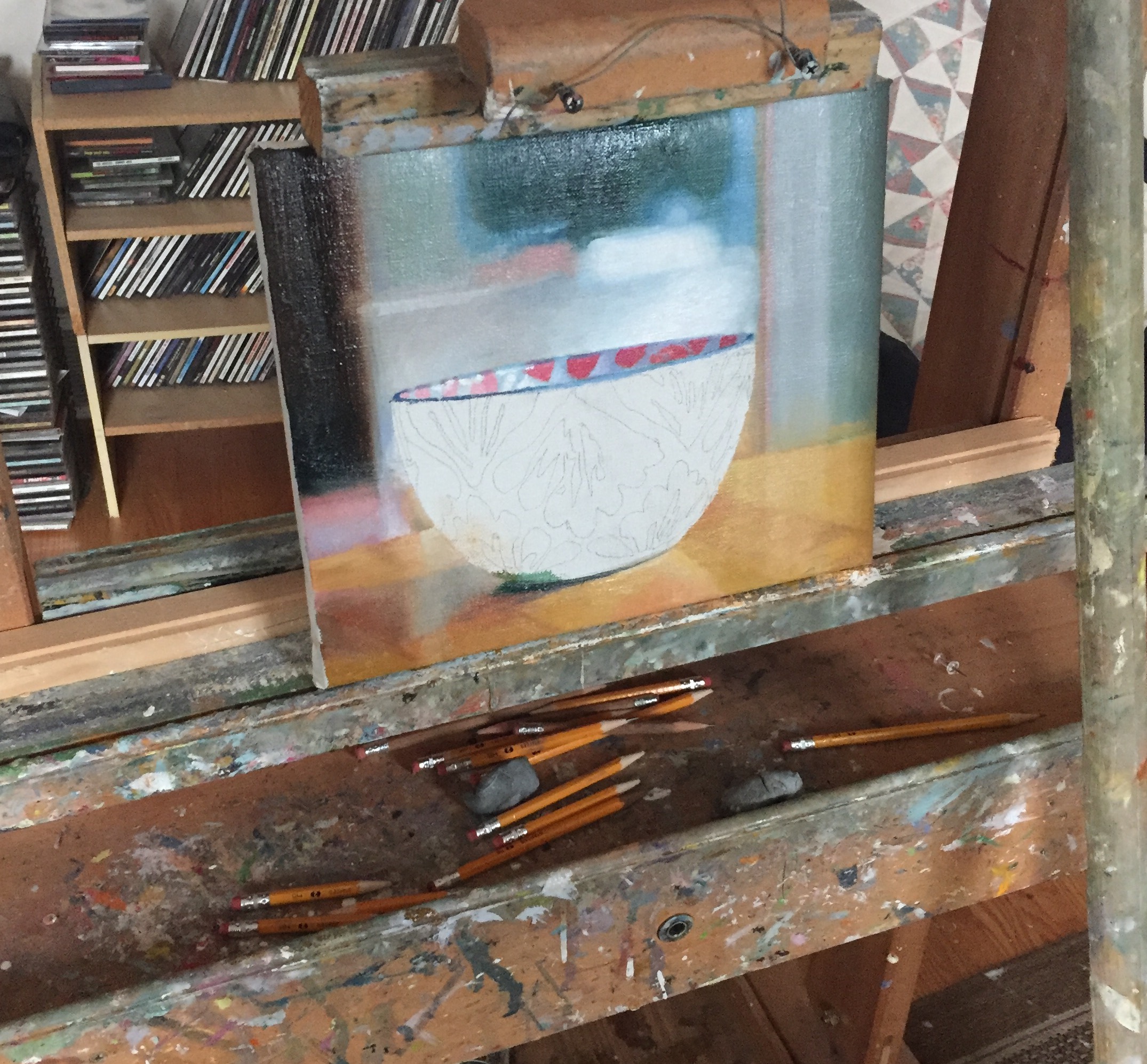 I’m finally back on a regular painting schedule, and it’s surprising how it puts me in a better mood—helped along by a few other changes in my life. Maybe this makes it odd that I’m thinking hard about taking a year off from exhibiting (while continuing to contribute to local group shows at Oxford Gallery) in order to take all considerations out of the act of painting other than the quality of what I’m doing, based on my own response to it. It’s difficult to resist the sense that I need to refine what I do into something that will either be exhibited or will sell, or both, as a way of validating my work. It’s a little silly to be consciously trying to eliminate these considerations, at this point in my life, since I didn’t give them any thought at all for most the years I’ve been painting—when I did it as a solitary pursuit. In other words, it doesn’t take much effort to quit worrying about a “career” because that’s never been the motivation. Imagine Cezanne or Van Gogh scanning their CVs with a worried look. Being able to both eat and paint is the goal. Whatever creativity is, you’ll kill it by putting a harness around its neck. Once you start showing and selling, as I’ve been doing for seven or eight years now, those activities become a reflexive consideration—you ask, will this be anything someone will want to show or buy? In theory, I don’t think that’s wrong; in fact just the opposite. With Dave Hickey, I agree that making art people want to own ought to be a central consideration, not because it makes sense economically, but because it means an artist is trying to connect to others in a way they’ll welcome. When you speak, you hope someone is listening, otherwise, you’re . . . well . . . you’re a blogger, right? But I’m putting that aside for now. If I give myself a hiatus from questions of selling and showing, I might be able to feel free to fail in an attempt to get better results while painting in ways I ordinarily don’t give myself permission to do. (Do I contradict myself? Very well . . .)
So, in this frame of mind, I’m finishing a small, modest still life of a bowl, using methods I’ve been trying for the past year. It’s the first of a series of small ornamented bowls I’m going to paint between now and the end of the year. In this one, as in the last few I’ve done, I’m being completely transparent about my use of photography. I depict one or two commonplace things as the focal point of the image and use a shallow depth-of-field to intentionally create blurred backgrounds. What I’m building is a series of still lifes that show objects in ordinary, everyday surroundings—not simply a wall or undifferentiated space—without rendering the background as precisely as the foreground. In other words, photo-realism, but not hyper-realism. The way I’m painting these backgrounds ranges from slightly blurred but recognizable to extremely out-of-focus scenes that dissolve into softly abstract geometry. It creates a sense of depth in a way some would consider too easy, probably, because it relies on how our eyes have been conditioned to recognize the way a lens alters the view, giving distant things a gauzy aura. I suspect what I’m doing would be dismissed these days by those attuned to what’s currently respected and what isn’t—photo-realism may be commercially viable, but I don’t have the sense that it’s in critical or academic favor right now. Will that last? Probably not. Do I care? No. Maybe a little (see above on Dave Hickey). But that’s precisely what I want to take out of the picture with my hiatus from thinking about sales and shows. With the way I’m working right now, I’m able to achieve pure areas of color that just wouldn’t have the same character if I were to render everything in the image with the same level of painstaking, realistic detail. So far, I like the results. I also like how this approach is encouraging me to find the most efficient way to apply color without losing a sense of clarity and immediacy in the image, despite the lack of detail in most areas. It’s a way of painting where I feel as if I’m using the simplest possible means to get the results I like, focusing on flat areas of color, putting one simple area of color next to another, as Hawthorne said, when he talked about “spots” of color.
None of this has anything to do with adhering to a theory, or some “better” way of painting, but is the result of paying attention to how the act of painting feels as I’m doing it, and whether or not I want to keep looking at the results when I’ve made a mark. It’s a way of savoring the tactile quality of the paint, so that I’m able to spread it in thicker layers and move it around in a way that actually, to me, feels like slicing into a cake—it’s full of that kind of anticipation. I’m sure it’s how Braque felt every time he touched his canvas with his brush. If you’re a painter, you’ll know what I’m talking about: the scale tips toward the paint and the pure color you put down, and the quality of both, while the illusion you create follows along behind, seeming to be summoned up almost as an afterthought of fitting all those shapes of color together in just the right way. I’m also finding myself achieving things with very small areas and gradations of color that undoubtedly nobody else will even notice. I do, though. Someone else, looking at one of these finished paintings might say, “I don’t get it. What’s so different about it?” And there you go: that’s exactly what I was talking about earlier, just painting with only my own eye and heart and hand as a guide, for better or worse, regardless of whether anyone notices what I’m achieving.
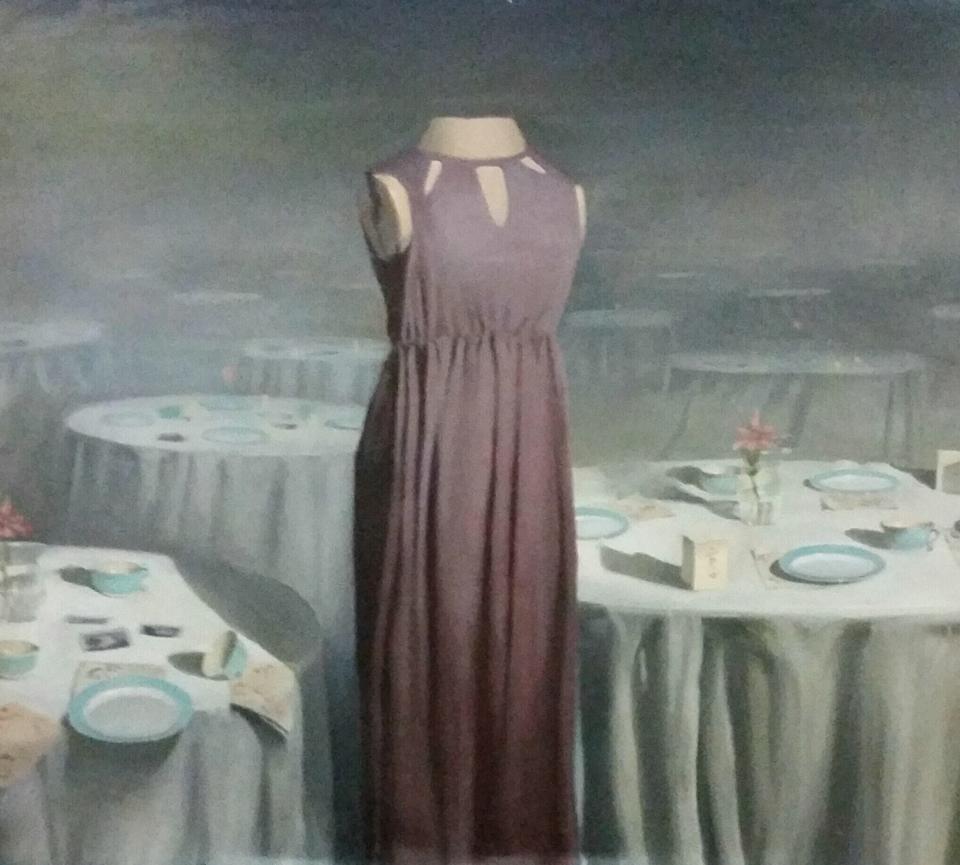
School Dance, David Stenulson, oil on paper 48 x 58
I’m happy to have a painting included in Monolithic, one of the current shows at Manifest in Cincinnati. It’s Cutting Loose, Breaking Free, a large oil of diaper pins clustered in my favorite jar, which I’ve used many times, for other paintings like it. Here’s the commentary on the show from the Manifest website:
Sometimes a particular work of art has a way of making us aware of our own physicality, helping us feel our bodies by giving us new perspective on our relationship to things around us. In MONOLITHIC, Manifest presents artworks from around the world that engage our sense of physical, intellectual, and emotional scale.
For this exhibit 82 artists from 26 states and 4 countries submitted 240 works for consideration. Fifteen works by the following 14 artists from 12 states and Canada were selected for presentation in the gallery and the Manifest Exhibition Annual publication.
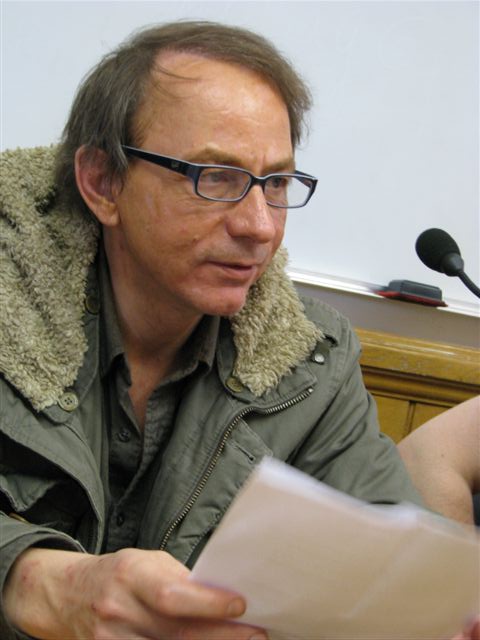
In two sittings I finished Michel Houellebecq’s latest novel, Submission, a mordant vision of an Islamic future for Europe though the eyes of a man in a state of hedonistic despair. I couldn’t put it down. To call it dystopian is to misunderstand its paradoxes; it simply works out the logic of where things might lead given current events in the Middle East and Europe, speeding up the timeline for Western culture’s surrender to a new order, with a whimper rather than a bang (there’s plenty of the other sort of banging on both sides of the velvet revolution here). The book’s central paradox is that Islam wins, which is both the bad news and the good news, depending on what page you’re on, and how wedded you are to the Western notion of equality. For the author, it seems secular culture built around self-fulfillment has exhausted itself. Houellebecq has been vilified for calling Islam “the stupidest religion” and yet the picture of the society that would follow from this cultural revolution, via a vote runoff, is actually depicted as a supple and peaceful correction to Europe’s socio-economic woes. He doesn’t find it repellent at all. It’s clear that Islam has allure for his main character who seems like an avatar for the book’s author.
For someone who has claimed to be an agnostic, who has said science is the only arbiter of truth, he conveys impotent spiritual yearning in a convincing and sad way. (Recent interviews indicate his views on religion have shifted, or have simply become clear, depending on how you interpret his remarks.) It’s a brilliant book and it made me laugh out loud, and yet it isn’t a satire. Through the mouth of the man who heads the new Islamic Sorbonne in the novel, Houellebecq downshifts into beautiful prose, which comes out of nowhere (given the tone of the rest of the novel), when the subject comes to Muslim worship:
For Islam, though, the divine creation is perfect, it’s an absolute masterpiece. What is the Koran, really, but one long mystical poem of praise? Of praise for the Creator, and of submission to his laws. In general, I don’t think it’s a good idea to learn about Islam by reading the Koran, unless of course you take the trouble to learn Arabic and read the original text. What I tell people to do instead is listen to the suras and read aloud, and repeat them, so you can feel their breath and their force. In any case, Islam is the only religion where it’s forbidden to use any translations in the liturgy, because the Koran is made up entirely of rhythms, rhymes, refrains, assonance. It starts with the idea, the basic idea of all poetry, that sound and sense can be made one, and so can speak the world.
Though he puts those lines into the mouth of a recent convert, he is deeply drawn toward this vision of an Islamic future. (The author at first tried to build the book around a conversion to Catholicism, but wasn’t happy with the results.) To put it mildly, the world he depicts would be a sharp U-turn from the path we’ve been on since the Enlightenment. It’s impossible to imagine Western women peacefully retreating from the workforce as they do here–or putting up with polygamy. It’s also possible to imagine many who would welcome a permanent vacation from the workforce. Houellebecq seems secretly drawn to Islam and feels a nostalgia for the retrograde social order it might bring. You might say he writes about it the way Milton once wrote about Satan, knowing the ostensible enemy is the most interesting character on the page, and maybe the real hero. He’s drawn to what he understands would be a sharp abridgement of all the freedoms that have made his career possible. Islam may loom like a conquering power here, but it would hardly be a despotic rule if the Islamic moderates from this novel took over. Their power grab proceeds through attraction, not force. This isn’t ISIS. The book doesn’t mock anything but the decadence of its central character, as a stand-in for the West’s decline.
Here’s a blast from the past from The Paris Review:
INTERVIEWER
But what stops you from succumbing to what you have said is the greatest danger for you, which is sulking in a corner while repeating over and over that everything sucks?
HOUELLEBECQ
For the moment my desire to be loved is enough to spur me to action. I want to be loved despite my faults. It isn’t exactly true that I’m a provocateur. A real provocateur is someone who says things he doesn’t think, just to shock. I try to say what I think. And when I sense that what I think is going to cause displeasure, I rush to say it with real enthusiasm. And deep down, I want to be loved despite that.
. . .
It may surprise you, but I am convinced that I am part of the great family of the Romantics.
INTERVIEWER
You’re aware that may be surprising?
HOUELLEBECQ
Yes, but society has evolved, a Romantic is not the same thing that it used to be. Not long ago, I read de Tocqueville’s Democracy in America. I am certain that if you took, on the one hand, an old-order Romantic and, on the other hand, what de Tocqueville predicts will happen to literature with the development of democracy—taking the common man as its subject, having a strong interest in the future, using more realist vocabulary—you would get me.
INTERVIEWER
What is your definition of a Romantic?
HOUELLEBECQ
It’s someone who believes in unlimited happiness, which is eternal and possible right away. Belief in love. Also belief in the soul, which is strangely persistent in me, even though I never stop saying the opposite.
INTERVIEWER
You believe in unlimited, eternal happiness?
HOUELLEBECQ
Yes. And I’m not just saying that to be a provocateur.

Georgia’s Stuff, Tom Insalaco, oil on canvas
I spent the afternoon talking with Tom Insalaco on Monday, at his home/studio in Canandaigua. It’s a home built in 1882 and now packed with several decades of work. He paints in what would have been the living room and stores his materials and finished paintings elsewhere on the first floor, including the original kitchen, and he lives upstairs, where he built a room that triples as a fully functional kitchen, a library and a media center. I want to write up the conversation we had but until then, I’m offering the large painting from 1987 that hangs on the landing at the top of his stairs. It’s around five feet square, and is paired with another brightly lit outdoor scene, at least as large, of several tourists standing beside Niagara Falls in full sun. The two paintings are so different–in color and light–from much of what he’s done since then that, when I saw them, I wanted to pull up a chair and study the work for a lot longer than I had time to do. This one captures a moment on a day his then-girlfriend moved into his place as they unpacked her stuff, a frozen cascade of clothing on which floats the dust lid from an old turntable, with the leaves of a big philodendron jutting into the scene, and a little ripple of a woven reed rug in the lower left. You can’t see it well from the iPhone shot, but there’s a taupe pair of narrow-wale corduroys, which became popular in the 70s, folded and sitting in a prominent spot in front of the chair bearing the turntable lid. The way Tom rendered the velvety shine is amazing, each cord distinct and visible. Tom’s artistic idols are Caravaggio, Rembrandt and Sargent, but he loves the photo-realists, and it’s never been more apparent than in this and its companion painting on that second floor landing.
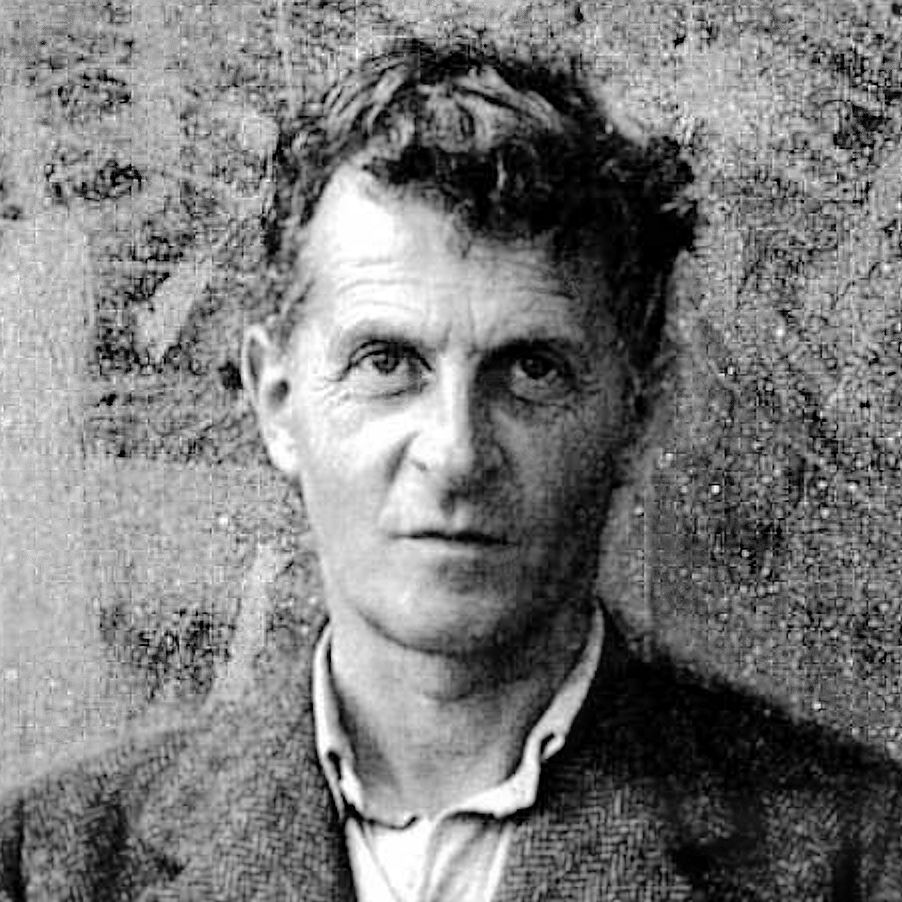
I’ve been reading above my pay grade, as it were, for the past couple weeks, delving once again into On Certainty, by Ludwig Wittgenstein. I minored in philosophy at the University of Rochester, and as a senior I took a graduate seminar mostly to study The Blue and Brown Books, and Philosophical Investigations. When I say “seminar”, I mean that I, and two grad students, met for several hours every week in the office of a tall Afro-American professor who packed tobacco into his pipe and inhaled the smoke (as he would have with a cigarette) for the duration of our conversation. He didn’t lecture us, but played Socrates, as Ludwig often did, too, as we thought our way forward. I was often baffled, if not completely lost, but not always. He was kind, and he never disparaged my beginner’s efforts.
I came out of it knowing what is commonly known about Wittgenstein: that he believed the cure for his philosophical obsessions was to see as clearly as possible how language was fooling him into asking questions, or coming up with theories, that were essentially pointless. Philosophy was a cure for philosophy. (Yet he kept doing it. Continuing to ask a question with no answers somehow matters.) This encouraged me because of my own history, at that point, of asking philosophical questions that had no answer, at least not the way ordinary questions have an answer, embedded in a sensible pattern of behavior, a “way of life.” My reading in that class supported something I’d come to see, through reading Kierkegaard MORE